Friday, July 6, 2012

Garage layout

I was asked by a YouTube viewer about plans for a garage railroad that appears as a 3D SketchUp model in a video I made several years ago. While I don't have measured drawings for the track work since we worked off of the 3D model, I do have some images of the track arrangement and photos of the finished piece as well as the bench work dimensioned plans we used for construction. I hope this helps him out with his own project.


The layout is in half of a garage and is a commissioned project for grandparents who wanted something to engage their grandchildren when they came over.  The end result is pretty nice for a garage layout, with fantastic mountain scenery by Chuck Ellis and the rest done by the owner, Tom Pearson and me.


Since the initial build, there were some changes made. There is an elevated town where the roundhouse was, and the town streets are a little different as well as several minor adjustments and detailing. It is, however, amazingly like the SketchUp model, and it was certainly a good way to present an idea for a layout to a customer.

Following that there is just a photo dump of some construction and detailing photos. I don't seem to have any photos of the finished product, which isn't good, so I will add that to my list.


Thursday, July 5, 2012

LDJ article

Look for a cleaned up and fleshed out version of the DYNAMOS article in the next issue of the Layout Design Journal. Weighing in at about 12 pages, the article in LDJ-47 includes some redrawn graphics and edited text in a convenient printed form.

Tuesday, May 22, 2012

Erie Dynamos in N Scale Part Deux

For the first part of the Continuous Model Railroad, see Erie DYNAMOS layout in N Scale

Applications (continued)

So let's apply the dynamo principle to the Erie Railroad. First we need to gather the prototype's track charts. We need the charts to know what the track alignments are in order to figure out our module requirements and configuration. The first chart on the Erie's east end is the Jersey City to Carlton, NJ that includes the large Croxton Yard complex. This covers the first 9 miles of the eastern end of the line.

The black blob is Croxton Yard between Jersey City to the right and Carlton, NJ on the left..

The next section takes us from milepost 10 at Passaic Park to Hohokus and mile 22, but we are only going to be able to make it to Paterson, NJ at mile 15 in the first session. Now we can look at the track arrangements and match that up to our stable of standard modules.

Part of the track charts for our journey to Chicago from Jersey City.


The classic model railroad problem is that we model railroaders want to fit 900 miles of railroad into 400 s.f. and Dynamos allows one to do that, just not all at the same time.
The space that I have to work with is a living room that measures about 16' x 20' which is convenient for a standard 2'x4' (or 1'-6"x 4' since this is N scale) module with 4' aisles. Included in each session will be staging modules at each end, so those will pretty much be set and all we have to do is fill in between. The corner and aisle turnback modules also end up being fixed for all intents and purposes since this is the best way of filling this particular size room in a traditional "E" configuration of modules. This means that all that will change from one session to the next are the 18 intermediate modules.
Our stable of standard abstracted Operational Design Elements modules
Module identification


The first session on the Continuous Model Railroad includes only modules "A" through "I" since we haven't hit the 4 track main line, yet, which starts at "WJ" tower at Ridgewood, NJ. In addition to the fixed requirements of staging (2 "H"s and 2 "G"s) and corners (6 "A" modules) we will need these quantities:"B" 2,"C" 1,"D" 4,"E" 4,"F" 2,and "I" 2. I would build the staging modules "H" on wheels to make getting ready for the next session a snap!


Session 1
How the sessions break down moving East to west. In retrospect, I might do the sequence starting in Chicago and moving west because there is a greater flow of loads moving East to NY. I could, of course, easily do this the second time around.
The next session sees only minor changes to the overall set up, only the names of the towns are changed. (This could be accomplished through a nice sign pocket on each module that allows for quick re-naming between sessions.) Session 2 will move us from Paterson to Suffern.


There are only six modules that need changing in this session. Shown with the red dots in the next figure, the major change is the addition of another yard at Allendale between Paterson and Suffern. Now sharp Erie railroaders will be cringing at this point, because I have been showing a two track main line in places where there should be four between Rutherford and Suffern. I honestly don't remember why I didn't do this when I originally presented this idea at the Tulsa LD/OpSig event a couple of years ago, but I can perform some post-rationalization at this point and say that it didn't make financial sense to build so many four track main line modules to only use in this session as almost all of the Erie was not four track main, or maybe I simply messed up.
Only a few changes are necessary for the second session.

Operations

It is now a matter of getting out our employee schedule to start working up our operating scheme for the sessions.
The part of the schedule that corresponds to the Session 1 area on the system map.

The Westbound schedule from Jersey City to Port Jervis that includes what we need to know for operations in the first few sessions.
Almost all of the trains run daily, so it doesn't really matter what part of the week simulate. I would choose a particular day to start off with, though, so that we could keep a consistent timeline going as we move across the country to make the experience more relevant. A little research will tell us what these trains are and what the normal consist would be. Moving westbound, a lot of the trains will contain empties moving back into the heartland where goods consumed on the East Coast are manufactured or grown.

So what gets interesting is how you set up the sessions. There are several possibilities, of course, and it depends on what you are looking to get out of the experience in order to determine how to craft the operating scheme. If one were interested in a particular train, one could operate a very slow clock and model only a couple of hours in each session so as to follow this train from end to end.

The Erie Limited, train No.1, for example, departs Jersey City at 9:30 AM each day, so operating the schedule from 9:00 AM to 11:00 AM the first session would see this train move from East to West and arrive at Patterson. In order for the next session to be properly aligned in time, No.1 would start at Paterson and the session would again start at 9:00 AM, because No.1 moves through Paterson only a few minutes after leaving Jersey City. In fact, since it makes no stops, No.1 is scheduled to depart Goshen, which would end up in our 4th session, at only 10:49. This means that the first FOUR sessions we hold are all modeling operations between 9:00 and 11:00 AM on one day.

During this time, however, all sorts of other activities are happening with locals, through and way freights doing their work. Since we are shifting our focus from East to West, we would see the same locals operate in the same direction each session. This would happen with the eastbound traffic as well with their entrance to the layout occurring a few minutes earlier each session until they no longer show up within the time frame set by our following of the train of our interest, No.1.

What is fascinating about operating the Continuous Model Railroad in this manner is that the trains operating during a given session would largely remain the same from one session to the next, as would the time. Differences would be small and mainly consist of when the train moved through the layout. The larger difference would be seen in the shifting of the towns from one session to the next, almost as if they were standing still and the layout were moving underneath them.

Another way to organize the operating scheme would be to model an entire day before moving on. This would place emphasis on the location rather than a selected train. This scheme would allow for an appreciation of the rhythm of the place, rather than the experience of the train. The understanding, then, of the whole trip from New Jersey to Illinois would be more about the patterns of the entire Erie Railroad. Appreciation is gained of busy commuting trains punctuated by a named passenger train or express freight and how this is mapped onto a daily pattern of traffic on the railroad.

By following a train across country as in the first example, the appreciation is centered on the experience of movement, not on the experience of place.The constant is the train - everyone will be focused on when the train is present in relation to the location. Time then becomes the measuring stick. It is as if we see the train as a second hand passing each city which is a number on the clock face.

Shifting the focus around by modeling an entire daily cycle in one location, the reference is switched from following a sweeping second hand of a clock to a static orientation based on where you are and gaze upon the face of the clock where a particular number is being passed by the clock hands. The same schedule and operations routine of a prototype railroad can then be experienced and understood in two completely different ways using the same layout space. 

Different understandings of a railroad

This is the crux of the whole idea of the Continuous Model Railroad: through the abstraction of space (the transformation of track arrangements into dynamo ODEs) and the ability to swap them around interchangeably (the Dynamos modular system), we are able to bring focus onto the temporal component of railroad operations, and because of that, experience railroading in a completely different mode than we are accustomed.

This shifts our perspective from the current practice of representing an entire railroad through a single specific instance to understanding each location of a railroad in relation to how the entire railroad operated. This effectively reverses the adage that we can understand the whole world through a single grain of sand to understanding each grain of sand by looking at the entire world. A microcosm representing the universal or the universe explaining the microcosm? The flexibility of Dynamos sets up a duality where you have a choice between the two, but you should really try both for the most complete understanding of the operations of your chosen railroad.

Module construction

I have been working on developing a lightweight modular system for a while now, but I don't have an ultimate proposal as of yet. A recent NMRA Magazine article described an aluminum angle and Masonite method that is similar to my thoughts. I've been looking at aluminum shapes, but I have not decided on the skin component. I've looked at honeycomb cardboard, Gator board and regular building insulation foam among other materials. I am leaning towards Gator board at the moment.

The other part to consider is what the modules will sit on. There are several examples out there from Freemo, Ntrak, and other module systems. My priorities include lightweight, ease of set up and tear down, and finally storage space required.

I would use standard code 80 track with manual switches. No need to complicate anything for modeling realism that might compromise operations. No layout is fun if you have derailments or power problems, so the simpler the better in this case.

Proof of concept

I guess the next thing for me to do is to actually try this. We all have good ideas, but do they mean much if we don't try them? I believe it would prove to be a worthy distraction from the Port of New York layout, but I don't think this will translate into HO, so I can't use any of the equipment I already have. I'm not sure I can justify this divergence of funds. I've only got a handful of N scale equipment at the moment, but maybe I could simply lease what I need. This is what the prototype would do...

If you are interested in hearing more about this, I have a slideshow of the presentation I made at the Tulsa convention.

More on the Continuous Model Railroad as it develops...

Monday, May 14, 2012

WP 1st Sub Rides Again

After a year long hiatus to attend to more pressing matters, Tommy Holt hosted a regular operating session on his Western Pacific 1st Subdivision layout set in and around Stockton, CA. We were actually pretty lucky that we operated after his building was struck by lightning (again) this week. He had some trouble that he worked around, and repairs started on electronic systems the day after we operated.

The kitchen aisle, as I call it. This is the heart of the layout. Stockton Yard is on the right and lines West to the left with the towns of Ortega, French Camp, Lathrop, and Cochran. Most of the crew is here (hence the kitchen reference where everyone gathers), front to back is Gordon, Bill, Jack, Tom and maybe Stan.


It was good to be back in the saddle again, and tonight I was breaking in the new guy. Brian, who had been to the layout only once or twice previously, and I ran mainline trains as is the custom with a rookie, so he can familiarize himself with the overall layout, rules and particulars before trying other more complex jobs. Brian is a member of Op Sig, so he has plenty of experience, and he caught on quickly.

A switcher sits quietly in a Flora Street Yard track with a long string of autoracks filled with freshly built Fords. I guess the work day is over here, as no one is in sight and the locomotive isn't even on.

It is lonely out on the road, especially at Altamont. Most famous not for WP's very useful long sidings, but rather for the free concert run amok hosted by the Rolling Stones in 1969 - three years after our train rolls through town in the late summer of 1966 on Tommy's layout.


We first ran OWPX, an eastbound freight expediter to Salt Lake City. I tried to explain as much about radio protocol, yard procedures, horn blowing, how to call the signals, etc. on the first trip and then just remind on the subsequent runs. He had operated on the layout before, so this was already familiar material. Here's some of the stuff we saw along the way.

We didn't stop at the call box today, so it was a quick pass through the sleepy control point at Trevarno.
A Merchandise Dispatch box car sits by itself on a track at the Kaiser gravel company at Radum. 
A front loader works to load gravel beyond the shack that houses the office at Kaiser.

The crossing to get to Kaiser.

Gravel hoppers ready to be picked up at Kaiser. The Rockswitcher didn't run tonight, so this will probably get picked up next session.

Stockton depot is always busy.

The depot was built by Mike Barrett after a trip to California to measure the existing building. Excellent work!

Something to mention is the "all off" switch seen here at the entrance to the layout. The red switch is lighted and turns off all the railroad related electrical circuits for safety considerations. This way you know everything is off whether for working on the layout or at the end of the evening when it is time to tie up.

I keep meaning to ask Tommy why this says "(RILEY)". If I know the building this refers to, it is a concrete structure with Egyptian detailing on it. I've seen a few pictures online, and it is an unusual building. It is located near the ST&L interchange near the Flora Street Yard.
Headed into the hole at West Staging through the SP crossing at Radum.

Blowin' and goin' through Flora Street (although in this part of the railroad, it means we were probably going about 15mph...) This is Weber Ave. with the SP tracks crossing in the foreground.

Brian minds the signals moving through Tracy on the west bound extra out of Stockton.

We ran a couple of other trains including the Auto Parts Forwarder (APF) and a westbound freight extra (WPW) without incident. The extra was the last train of the evening for us, so I let Brian take it solo, and I just hovered in case I was needed. He did great, and from what I could tell, he enjoyed the evening tremendously.

The ongoing conversation for us this evening was about how long it took to learn all the rules and how we were trained, etc. I can't remember exactly how long I've been operating at Tommy's, but it has been close to 8 or 10 years. Sounds like a long time, but it isn't if you remember that at best we operate 10 times a year and there are at least 8 different jobs on the layout. That means out of about 80 possibilities to do a job in 8 years, you probably have not done each job more than about 10 times. This is not a lot of practice when it is spread out over several years. With this in mind, it is impressive that there are several people who are really good operators of the layout. At this point the evening is usually uneventful in terms of mistakes. We can now concentrate on efficiency and enjoying the ride more now that we are not trying to remember rules or procedures. Even after a year long lay-off, we all just fell back into the groove.

Tuesday, May 8, 2012

To (and From) Russia (on Trains) with Love

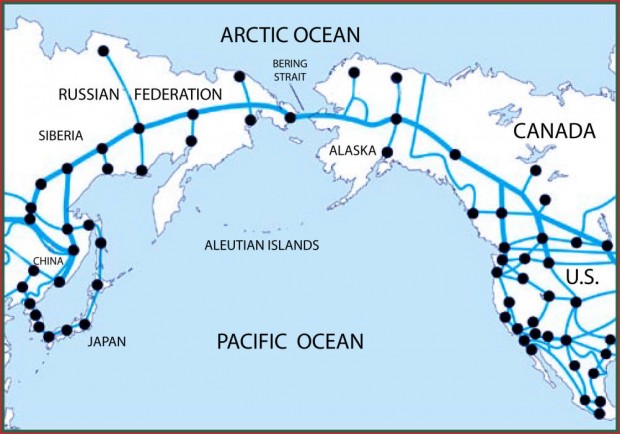
Sounding like a 19th century Napoleonic missive (see the history of the idea to build the Chunnel between Britain and The Continent) there is talk about building a tunnel in the Bering Strait to connect the US with Russia by rail.


The proposed connection between the US and Russia via inter-continental rail


This is quite an idea, and it, too, was thought about long ago (a musing of Czar Nicholas II in 1905), but the economics of it are apparently now ripe for the actual mission to take shape. Seems the Chinese are also keen on this, and with three of the largest nations on earth all thinking about doing something, it just might happen sooner than later.

I'm certainly excited by the idea, and I might start saving my pennies to take that train trip (although in reality it would probably be miserable as a passenger and more exciting and easier for a piece of freight to be shipped to me "ground service" from China). This could mean a whole new category of rain service - the ultra-long distance freight express.

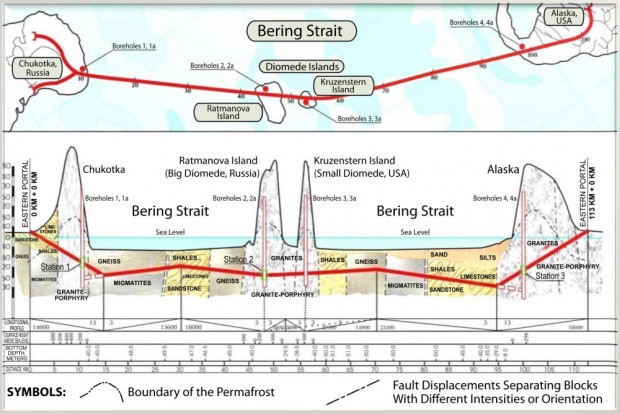
So my question is, naturally, how could one model this new ridiculously long route? It would be a great candidate for the continuous model railroad Dynamo concept, of course, but what other ways might this vast and frozen route be tackled? I'm feeling a little silly at the moment, so I might take on the tunnel itself.

"What on Earth is this guy thinking?" Well, I'm thinking that the most important signature element this railroad has to be the bridge and tunnel system that gets the railroad across the Bering Sea. Viewed as either an LDE (a layout design element) or an ODE (an operational design element), the tunnel layout would not be a John Allen subway line, but rather more like an Iain Rice portrait layout that captures the essence of what the railroad is at that point - under water, probably going quite fast, and cold. Some interesting things to model.

A cross section of the proposed Bering Strait tunnel. How would this translate into a model railroad?

Capturing those elements would be a fun challenge. Imagine a layout whose backdrop was actually more of an overdrop extending down from the valence and right in your face. A model of a cross section of frigid ocean water and life would be quite stunning. Then below the very narrow strip of train tunnel at eye level would be a think cross section of sand, rock and earthen modeling that would make for an unusual framing for a railroad. The trains would move fast (who wants to slow-poke it through a mulit-kilometer underground and undersea hole), and they would probably be container trains. Maybe a new type of container for this different sort of trip? I would think the  locomotives might rate a new look and functionality as well - perhaps ones with sleeping berths and extra fuel compartments integrated into them?

Such a layout would be future-projecting, which doesn't happen much in model railroading. Most of the alternate realities are simply freelance or what-if railroads whose validity comes from being as believable as possible to fit into an existing context. But there are not many (any? Tell me about them if you know of one!) that are set in the future? What happens to the hobby activity when it becomes speculative (like a freelance railroad) and also forward-looking?

The modeler would necessarily become more like a sci-fi author/designer having to extrapolate and extend the railroading of today into a future setting that has new constraints and needs to be designed for. What a great opportunity to experiment and play with scratchbuilding new locomotives, liveries and specialized rolling stock. The scenery would be out of the norm, the presentation unusual at least, and the demand on creativity very high. Might be a good challenge for someone out there who has mastered recreating railroads from memory or research, and who is up to the challenge of designing a railroad mostly from sheer creative vision.


Saturday, April 28, 2012

Book Review: Layout Design by Iain Rice


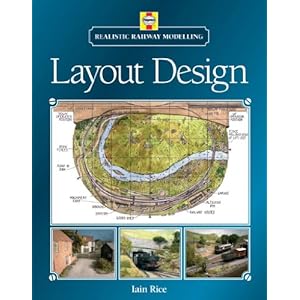
The first book in a new series by J H Haynes & Co, Ltd, Realistic Railway Modeling, is Layout Design (2010) which is as much a slice of philosophy as it is a hobby guide book. Written by prolific British author Iain Rice, the tone and flow of this book is informal and smart, and promotes a particular approach to modeling that is informed by the author's artistic schooling.

This 176 page hardback retails for $34.95/£25.00 and is presented in a clean, color-coded scheme with sans serif typeface that moves from overall philosophy and approach to the hobby through "Boring Bits" and the "Things You Can't Ignore" chapters to the heart of Rice's argument in the "Visual Design and Presentation" chapter. Only after all these have been rightfully considered along with prototype research, logistics and operational considerations does he address the actual plan for your layout. He notes in his "Preliminaries" chapter that the track plan has traditionally been held as "the only blueprint needed to build a model railway." 

Not so, as Rice argues for a more complete and holistic method of design that resolves all issues of the layout from the perspective of finished product. He puts forth that design considerations must involve viewing perspectives, operational desires, visual harmony and proportion as well as the nuts and bolts of the construction. The artistic elements are where he places emphasis, and the rest of the pieces are supporting cast to achieve his goal of a realistic model railway - including the track plan. The effect of the layout as a whole is the prime motivator.

I could not agree more with Mr Rice about designing holistically. Too many times I have consulted with clients and friends over track plans. Too many times I have tried to get them to think in these holistic terms, only to be humored for a few minutes before turning back to the track plan as the central organizing principle of a layout. It could be that people are thinking of the track plan as the plan view for the layout. I believe it was Mies van der Rohe who promoted the primacy of the plan as a generator for good architecture, but he was after different overall effect than a model railroader. 

Mies was organizing space to be experienced from within. Adjacencies, relationships, proportionality and materiality were key ingredients for the experience of an inhabitant. While all of these ingredients are also key in the development of a model railroad, the viewpoint of the experience is almost completely exterior to the space itself. It is much more akin to a painting or sculpture than a work of architecture. The arrangement of ingredients must be thought of in terms of the gaze and not the experience of being in a three dimensional space. So in model railroading, the track plan must be considered an ingredient, too, and not the primary organizing element. The better method of organizing space in a model railroad must be in something more like the perspectival vignette sketch that allows for the understanding of the visual relationships of the different elements in the layout. 

It is not surprising, then, that Rice's main graphic tool for developing and communicating his layout designs is the perspective sketch. His signature sketches - usually rendered in color -  allow him to consider the placement of buildings, roads, landscape, backscene, and tracks as an entire composition for a holistic design approach. 

In the "Visual Design and Presentation" chapter, he shows that this sketching method for designing affords consideration of proportion, composition, viewing angles, scene division and visual balance. It is also a way to test out "sizes, mass and scale of objects and their placement in the scene." He suggests some basic techniques for this such as using the Golden Mean (or Golden Section) to find the appropriate boundary areas for locating things. All of this is to support his main goal, which he sets out in the introduction: to create a believable and realistic ambience of a prototype railway. 

Throughout the book, Rice includes many great devices for framing how one should think about layout creation by setting of parameters. His first parameter is to set a general approach of "compromise and deception" to achieve the desired ambience. Then, in order to create this ambience, one must nail down underlying motivations to arrive at a guiding mission statement with which to evaluate all decisions. Using this approach, a layout practically designs itself - all you have to do is figure out the constraints and goals you have, then stick to them throughout all the rest of the decisions!

He explicitly addresses this in the chapter "Rationales, Lists and Logistics". He suggests using lists to help organize your thoughts and prioritize desires. Ironically, one of the few things I find missing from the book is a list of things to do while designing a layout as a way of condensing the whole book into an actionable guide for the reader. I would suggest making this list for oneself, starting with why you are even building a layout to begin with. 

I very much enjoyed reading Mr Rice's overall look at designing a layout. It is an easy read and well illustrated, presented and produced, and I'm looking forward to seeing more of this series. This is a great book, especially for the beginner who is wondering what model railway building is all about. As an intermediate or advanced layout designer, this can help clarify what you may already do, but give you more control over the process.

What I am left with is the interesting contrast in approach to modeling between Rice and many of the mainstream American model railroading authors. This is something that may be worth thinking about in the near future.


Wednesday, April 11, 2012

More GN&P Photos

Taliesin on one of the three railroads on the layout. The narrow gauge Cisco and Taliesin runs down the middle aisle out into the expanded mountain room. Meaning 'shining brow' in Gaelic, this is the headquarters of the C&T and home to a yard, turntable and loading facilities. 
As promised, here are some more photos of Chuck Ellis' Great Northwestern and Pacific layout. Sorry about the quality - these are only snaps from a phone. We'll get in there and take some "real" pictures later on.

Dick Sowash gives me a tour of the structures he has put together in Taliesin. Dick is a really great modeler, and he has spent the last couple of years populating Taliesin and Great Falls.

An overhead shot of Taliesin. 
Don't look at the 3rd floor balcony of Judy's Bed and Breakfast.

Water tower and coal shute. 
We need about 14 more stalls added on to the roundhouse.

Sunday, April 8, 2012

Evolution of Railroad Logos

I ran across a nice entry in designer Christian Annyas' blog about the evolution of railroad logos. There is a nice cross section of logos representing many different railroads showing how the designs have gone from wood type to modern styling. (I'm sure your favorite railroad is represented.)

Kansas City Lines 1940
Also on this blog is a nice series of posts on the typography of the Sanborn Fire Insurance maps.

Brooklyn Suburbs 1895

Saturday, April 7, 2012

Temple Railroad and Heritage Museum

I just got a very nice note from Cynthia at the Temple Railroad and Heritage Museum who had seen an earlier post of mine about the Santa Fe station where it is housed. She provided some additional helpful information for those wanting to visit, and answering the question about how the passengers made it out to the Amtrak trains past the iron fencing. (original post)

If you are in the area, stop by and see their displays and lovely building. The Central Texas Modelers are also just a short distance across the parking lot in their own building with operating model railroad layouts.

Cynthia's informative email:

Recently I've been looking at photographs and artwork to link the our Pinterest site. While doing so, I came across your Wordpress Blog Page.  The link for the page about Station Stops http://austinfieldoffice.com/modelrailroad/archives/360, was one of interest to me. 
Here is the information you are needing to link your page to the Temple Railroad and Heritage Museum: www.rrhm.org, also you may find us on Facebook at http://www.facebook.com/pages/Railroad-and-Heritage-Museum/119089421449689
and now on Pinterest at http://pinterest.com/templerrhm/.
The regular hours of operation for the Museum is Tuesday thru Saturday from 10 am - 4 pm. We are closed on Sunday and Monday.  Admission to the museum is $4 for Adult, $3 for Senior, $2 for children between the ages of 5-12, $0 under age 5 and Military (with Active I.D. presented) is $0
If you would require any additional information, I'd be happy to assist.
Thanks for posting such nice photos of the Santa Fe Depot.
Also, the Amtrak office is located at the West side of the Santa Fe Depot with a ticket agent on duty Monday - Friday from 9:30 am - 6:00 pm.  They also have staffing just prior to departures and arrivals on Saturday and Sunday--dependent on the number of guests traveling.
They 'load' passengers directly in front of the South Entrance of the Depot.  The ticket agent/or train conductor unlocks the gate when the train arrives. 
Hope this answers some of the questions that you posed on your blog page.
Sincerely,
Cynthia.
Cynthia R. Coyle
Temple Railroad and Heritage Museum
315 West Avenue B
Temple, Texas 76501
cynthia.rrhm@sbcglobal.net
Museum: 254-298-5172
Fax: 254-298-5171