Showing posts with label design. Show all posts

Wednesday, May 21, 2014

Getting Ready for A Convention

By author

For the LSR Region's convention The Bluebonnet Limited this year, several preparations are frantically finishing up as we get closer to the opening day. One railroader in town is operating for the first time in several years, and needed a map of the layout to help orient visiting operators.

I created the quick map above was created with Adobe Illustrator in a couple of sessions. This is a simple map for people navigating, not train navigating. Exits are important, but the main thing is to help get the operators from town to town in the twists and turns of a somewhat confusing room arrangement. straight lines were used for speed and for clarity. It is not to scale, although it is pretty well proportioned for being done from memory with no measurements. It will be printed on a half sheet 8.5 x 5.5.

There are a perhaps hundreds of these sorts of things going on all over town as we speak as happens at any open house, meeting, convention or event. It is a lot of 'work' to host something, but it is a lot of fun creating fun for guests.

Chuck and Nan's layout is amazing, and maybe there will be some pictures here in the future, but in the meantime, check out the teaser on the convention web site.

Saturday, April 28, 2012

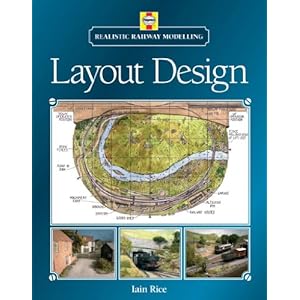
Book Review: Layout Design by Iain Rice


The first book in a new series by J H Haynes & Co, Ltd, Realistic Railway Modeling, is Layout Design (2010) which is as much a slice of philosophy as it is a hobby guide book. Written by prolific British author Iain Rice, the tone and flow of this book is informal and smart, and promotes a particular approach to modeling that is informed by the author's artistic schooling.

This 176 page hardback retails for $34.95/£25.00 and is presented in a clean, color-coded scheme with sans serif typeface that moves from overall philosophy and approach to the hobby through "Boring Bits" and the "Things You Can't Ignore" chapters to the heart of Rice's argument in the "Visual Design and Presentation" chapter. Only after all these have been rightfully considered along with prototype research, logistics and operational considerations does he address the actual plan for your layout. He notes in his "Preliminaries" chapter that the track plan has traditionally been held as "the only blueprint needed to build a model railway." 

Not so, as Rice argues for a more complete and holistic method of design that resolves all issues of the layout from the perspective of finished product. He puts forth that design considerations must involve viewing perspectives, operational desires, visual harmony and proportion as well as the nuts and bolts of the construction. The artistic elements are where he places emphasis, and the rest of the pieces are supporting cast to achieve his goal of a realistic model railway - including the track plan. The effect of the layout as a whole is the prime motivator.

I could not agree more with Mr Rice about designing holistically. Too many times I have consulted with clients and friends over track plans. Too many times I have tried to get them to think in these holistic terms, only to be humored for a few minutes before turning back to the track plan as the central organizing principle of a layout. It could be that people are thinking of the track plan as the plan view for the layout. I believe it was Mies van der Rohe who promoted the primacy of the plan as a generator for good architecture, but he was after different overall effect than a model railroader. 

Mies was organizing space to be experienced from within. Adjacencies, relationships, proportionality and materiality were key ingredients for the experience of an inhabitant. While all of these ingredients are also key in the development of a model railroad, the viewpoint of the experience is almost completely exterior to the space itself. It is much more akin to a painting or sculpture than a work of architecture. The arrangement of ingredients must be thought of in terms of the gaze and not the experience of being in a three dimensional space. So in model railroading, the track plan must be considered an ingredient, too, and not the primary organizing element. The better method of organizing space in a model railroad must be in something more like the perspectival vignette sketch that allows for the understanding of the visual relationships of the different elements in the layout. 

It is not surprising, then, that Rice's main graphic tool for developing and communicating his layout designs is the perspective sketch. His signature sketches - usually rendered in color -  allow him to consider the placement of buildings, roads, landscape, backscene, and tracks as an entire composition for a holistic design approach. 

In the "Visual Design and Presentation" chapter, he shows that this sketching method for designing affords consideration of proportion, composition, viewing angles, scene division and visual balance. It is also a way to test out "sizes, mass and scale of objects and their placement in the scene." He suggests some basic techniques for this such as using the Golden Mean (or Golden Section) to find the appropriate boundary areas for locating things. All of this is to support his main goal, which he sets out in the introduction: to create a believable and realistic ambience of a prototype railway. 

Throughout the book, Rice includes many great devices for framing how one should think about layout creation by setting of parameters. His first parameter is to set a general approach of "compromise and deception" to achieve the desired ambience. Then, in order to create this ambience, one must nail down underlying motivations to arrive at a guiding mission statement with which to evaluate all decisions. Using this approach, a layout practically designs itself - all you have to do is figure out the constraints and goals you have, then stick to them throughout all the rest of the decisions!

He explicitly addresses this in the chapter "Rationales, Lists and Logistics". He suggests using lists to help organize your thoughts and prioritize desires. Ironically, one of the few things I find missing from the book is a list of things to do while designing a layout as a way of condensing the whole book into an actionable guide for the reader. I would suggest making this list for oneself, starting with why you are even building a layout to begin with. 

I very much enjoyed reading Mr Rice's overall look at designing a layout. It is an easy read and well illustrated, presented and produced, and I'm looking forward to seeing more of this series. This is a great book, especially for the beginner who is wondering what model railway building is all about. As an intermediate or advanced layout designer, this can help clarify what you may already do, but give you more control over the process.

What I am left with is the interesting contrast in approach to modeling between Rice and many of the mainstream American model railroading authors. This is something that may be worth thinking about in the near future.




Sunday, April 8, 2012

Evolution of Railroad Logos

I ran across a nice entry in designer Christian Annyas' blog about the evolution of railroad logos. There is a nice cross section of logos representing many different railroads showing how the designs have gone from wood type to modern styling. (I'm sure your favorite railroad is represented.)

Kansas City Lines 1940
Also on this blog is a nice series of posts on the typography of the Sanborn Fire Insurance maps.

Brooklyn Suburbs 1895

Friday, August 6, 2010

September MR Editorial


Editorial or advertisement?


I am a casual reader of Model Railroader magazine every month (or two or three as I often let them pile up before consuming). I say casual because I don't read every word, but rather I skip and jump through the articles, mainly enjoying the pretty photographs as I would gazing out a car window at the scenery: I make note of interesting things, but for the most part I just enjoy the activity, and MR is a great publication for that. The only things I read closely are the editorial and Tony Koester's "Trains of Thought" column, which is the best thing in the magazine. The Sept 2010 issue was no exception, and I am motivated to comment because of the editorial.

Editorial


I find a less-than-minor annoyance in the editorial by Neal Besougloff that read as an advertisement for all things MR. The point of the editorial was that MR publishes a lot of special issues under separate titles every year, and that MR magazine alone can't publish all of this information desired by readers by itself. After running down a laundry list of these special publications, the editorial concludes with instructions on how to order them. To me, the editorial is a space for the editor to voice his opinion about the subject of his publication and/or frame the topics that follow in order to add value to the reader's experience of the material the editor has compiled. This month's editorial was simply an advertisement.

This seems indicative of the editorial direction of the publication. Understanding that the publishing industry is on the ropes at the moment and that MR is a for-profit venture, MR has consistently displayed a commercial face with regards to how it treats its advertisers and the lack of citations within its pages of other publications in the hobby. It heavily moderates its online forum to delete references or links to other publications and is generally defensive about its market share. I will reiterate that MR is a for-profit venture, and further say that it all of these actions are perfectly normal and can be seen as good business practice (albeit not good if you take the long view of the situation where dedication to the content makes for a more valuable product) . What bothers me is that it is so obvious and actually gets in the way of  the delivery of content in the magazine, like taking up editorial space to advertise its own products. It is inconceivable that they or any other publication would take advertising space to editorialize, so why is it OK to do the inverse?

Thinking man


A second notable aspect of the editorial is found in the body of the editorial is a mention of Tony's Model Railroad Planning described as a "thinking man's guide to model railroading". I found this very humorous and telling at the same time. It does two things - it says that Tony's column is an intellectual cut above the rest of the publication, and it says that the rest of the publication is not about 'thinking.' What this indicates to me is an implicit acknowledgment there are two different approaches to model railroading (and, by extension, everything in life).

The two different approaches can be expressed in many different dichotomies that relate to a division of  Thinking and Technology. From a discussion about the term 'design'.:

Modern bourgeois culture made a sharp division between the world of the arts and that of technology and machines; hence culture was split into two mutually exclusive branches: one scientific, quantifiable and “hard,” the other aesthetic, evaluative and “soft.”


What we see in Neil's description is this same rift in model railroading between the hobby practiced as an intellectual approach to creation, and one that is a craft approach to artifact building. Not saying either is better or worse - I am merely pointing out that this difference does exist, and we should embrace both and not be threatened by either - but I would like to see more of a balance between the amounts of the two approaches seen in publications for the hobby. It is then the place of design as a distinct activity to unite these two to produce a superior product that neither could do on its own. A  for-profit magazine such as MR should strive to achieve a similar balance between focusing on creating valuable content and the extraction of monetary value from presentation of content.