Showing posts with label Model Making. Show all posts

Saturday, March 22, 2014

Apocalyptic Perspectives and Dystopian Dioramas


Model railroading can be a lot more than an escape from everyday life. It can be a method of understanding and exploring much more challenging situations and conditions of our world. A rarely taken trajectory in modeling is the depiction of dystopic scenes of dark realities.

I came across the first of a handful of darker dioramas some years ago. It is the work of a Yale architecture student (probably graduated by now)  Peter Feigenbaum in his Trainset Ghetto installation. Plenty of graffiti and trash in a rough contemporary urban scene. The lack of scale figures makes it even more foreboding and bleak.
Bleak, barren and broken.
What do we get from modeling a gritty, non-romantic area of urban blight? Maybe it has to do with a deeper, more real, feeling of reality. The dark and ugly are often more vivid and touching events in our own lives that perhaps provoke much more emotional stimulation than the joyous occasions. This is definitely not a normal trajectory for modelers, but I suggest that it is just as satisfying, if not more so, than modeling the sentimental, happy, idyllic scenes of our childhood or romantic notions of better times past that are more fiction than fact. Peter's dirty reality is not the only one I've stumbled upon that plucks at the grim emotions of uncomfortable situations.

Thomas Doyle is another artist who uses scale modeling as his medium to explore difficult and transformational events that are often less than happy scenes. His artist's statement indicates he is after those deeper emotional moments.
My work mines the debris of memory through the creation of intricate worlds sculpted in 1:43 scale and smaller. Often sealed under glass, the works depict the remnants of things past—whether major, transformational experiences, or the quieter moments that resonate loudly throughout a life. In much the way the mind recalls events through the fog of time, the works distort reality through a warped and dreamlike lens.

Another artist James Cauty is dabbling in the scale model railroading medium shows us an extended crime scene. Police, investigators and a general environment of mayhem poke at the establishment through nicely detailed work of architectural modelers. He wants us to consider our relationship to authority in a large installation. The 'layout' is,
far from the rural idyll of old model villages, Cauty’s diorama makes a political statement about societal freedom and state control.
Collateral damage from the getaway chase.
A description of the installation:
A motorcade brings the queen to view the scene of the crime.
Thousands of police swarm over a scorched landscape tattered and torn by rioting and looting, every window in every building is smashed, vehicles are overturned, bridges and roads destroyed, power pylons are down, a burned-out church still smoulders. Above this post-mayhem scene of destruction, helicopters shine their searchlights on the battered landscape. Above the helicopters, a train rumbles past...
These art works are designed to communicate a theme or some sort of meaning beyond just recreating a part of the world. They are all dark in some way, whether through the topic, the execution or the exploration of uncanny emotions. They are all by artists and not modelers. While everything we build communicates about the conditions of the building process, intentional, overt and explicit communication through models is what transforms the pursuit from a pastime to an art form (or a design form).

The above examples are nominally works of art simply for the fact that they were produced by artists for art galleries. What happens if model railroaders build layouts in their homes that create a recognizable message about society?  Are they even modelers anymore, and are they now, instead, artists? A quick search of the Internet reveals on the UK N Gauge Forum that this approach is being taken up by at least one modeler.

The forum participant, Mr Grumpy, is attempting to tap into the dystopian visions offered in such movies as The Matrix, Blade Runner and 1984. His N scale modeling is intended to portray the "divide between rich and poor" with skyscrapers built on "crumbling slums below." His layout is still in construction, but his exemplary video from Final Fantasy VII indicates it is definitely headed towards gloomy futurism:


Off the top of my head for my own Hoboken Shore layout, I have a couple of items to possibly explore grittier sides of the rough Hoboken waterfront. One is at Bethlehem Steel during the union strike of 1947 (as seen in the photo below) when almost 42,000 workers on the east coast paralyzed the ship building yards.

Picket line of Bethlehem Steel strike of 1947
Also of note are the extreme signs of poverty found in Hoboken at the time due to graft and corruption of Mayor McFeeley's regime. Garbage collection was suspended at a point as political retaliation, and the large numbers of out of work immigrant merchant marines and large population of poor children roamed aimlessly about the streets. Almost every other building seemed to be vacant at the time, with squatters inhabiting half-crumbled structures. An article appeared in the US Camera journal (in the collection of Hoboken Historical Museum web site) that illustrates the dire situation of the city in the 1940s. The entire article is interesting and posted in its entirety in their online collections.

From US Camera Vol IV, No.2
And equally ripe for dystopic modeling is the tough harbor life as seen in On the Waterfront with Marlon Brando, where apparently there were lots of longshoremen beating up each other. Far from the cute or funny scenes of overturned apple carts or skinny dippers normally found in a model railroad, I am contemplating these dark depictions to accurately portray how awful life was in this area of New York Harbor. It would be misleading not to model these scenes that were so important to the culture and environment in which the Hoboken Shore Railroad operated during the 40s and 50s. Certainly not the glamour and polish found in streamline passenger trains and glorious stations one more often sees in layouts and railroad press, but I wish to present a rather dirty, poignant slice of a hard everyday existence of which the railroad was a part.
Marlon Brando as Terry Malloy gets pounded by mobsters On the Waterfront (Horizon Pictures, 1954)
This is definitely an underrepresented niche in the hobby that occurs in isolated instances in a few layouts. I think both dark modeling and the broader genre of artistic modeling bear some more thought in the pages of this blog at some point later. Meanwhile, there are a couple of recent examples of prototype opportunities to explore darker railroading topics.

A common occurrence these days are (old) tank cars from the Bakken Oil Fields making their way precariously through communities across North America while pipeline construction is catching up to the new oil shale deposit production. This catastrophe happened in Lac-Mégantic, Quebec, Canada recently, when a train with 72 tankers full of crude oil is parked uphill in Nantes, and through a series of unfortunate events, ends up 10 kilometers away exploding and burning in Lac-Mégantic.

I have seen plenty of firefighters and fire trucks on layouts fighting car or building fires, but I don't recall having seen a model of a railroad accident. (Feel free to point me towards any examples in the comments section!) The discussion of dark layout subjects is simply to illustrate the idea that not all layouts have to glamorize what is in reality the very dirty, rough and dangerous business of railroading.


Another instance of a prototype event that seems to beg to be modeled for a contest model or RPM meet. From an email circulating through the railroad community:
CN train that hit a log truck on the Redditt sub (between Winnipeg MB and Sioux Lookout ON) at Sunstrum, ON (mile 38). Lead unit was the 5146 a GMDL SD40. Seeing the truck on the crossing before hitting it with the train, the engineer hit the deck below the window level and the head end brakeman ducked down behind the wall and door under the middle windows, that leads down to the nose of the engine. Both made it out alive. There was glass everywhere, the pulp logs loaded cross wise on the truck, penetrated into the cab including through the number boards.
Quite an amazing image, and equally amazing the crew wasn't killed. I haven't seen anyone tackle a modeling project such as this.

Why don't we see more modeling of disasters and unpleasantness? I think one answer is rather simple and straightforward: why would a 'normal' modeler want to spend a lot of time ruminating on a layout that was dystopic? That certainly couldn't be a happy retreat from the hassles and tragedies of everyday life, which is a big reason to have hobbies in the first place. I think that there is, however, satisfaction and respite in creating more challenging layouts with unpleasant or uncomfortable topics, and there is an equal sense of recreation to that pursuit.

There are also benefits for the final product of the layout itself, whether it is dystopic, idyllic or somewhere in between, if we approach creation of it from a more considered perspective of an artist or designer.

I believe that layouts that have a carefully conceived theme or thesis statement are generally better off than those that do not. In more general terms, and with dark and grittiness aside, there is a lot of room for layouts having identifiable themes and theses to be less craft-focused and more artistically focused. There are a lot of distinct situations available for such modeling found in many varied kinds of prototypes.

Getting the look of a railroad accurate is a technical pursuit, but getting the feel of the railroad is a more artistic endeavor. To be thought about more is why this more artistic approach would be beneficial, and how a rigorous thesis statement could help make decisions and provide productive focus for the modeler. It has everything to do with the process producing a better outcome. Simply put, it is identifying what effect you are trying to achieve beyond making a model look like its real life prototype. What is your layout's thesis statement? This may not be part of your current process, but it deserves a little consideration.

Speaking of process, I see that the glue is dry, so I need to get back to laying track.

Thursday, October 24, 2013

Outdoor Photography of [Exquisite] Models


Some great models and photos from professional model maker and photographer Michael Paul Smith. He builds classic car models and photographs them in a fictional 1950s American town called Elgin Park. His models are so detailed that when placed in miniature dioramas and photographed using forced perspective, you'll think that they are real vehicles. His Smugmug gallery has a lot more examples.

A simple board with modeled concrete and great models in front of a strategically framed location is all that it takes to create a stunningly realistic image.


Thursday, July 11, 2013

Freight Car Trucks

From Richard Hendrickson's Freight Car Trucks, June 26, 2013

I shouldn't assume that everyone else knows about this kind of stuff before I do, so it bears pointing out that Tony Thompson has posted an update to the really fine compilation of HO scale freight car trucks by Richard Hendrickson. Richard provides an invaluable tool to anyone who is trying to model rolling stock in a prototypical manner. 

Someday I'll turn my attention to these finer points, but at the moment I'm deep into trying to translate a prototype track plan into a layout. The nuances of balancing reality, operability and presentation are challenging enough at the moment, so the fine scale modeling is on hold.

Oh, and in case I haven't said this before, Tony's blog always provides thoughtful, well-researched posts especially in the areas of freight car modeling and waybills.

Friday, June 7, 2013

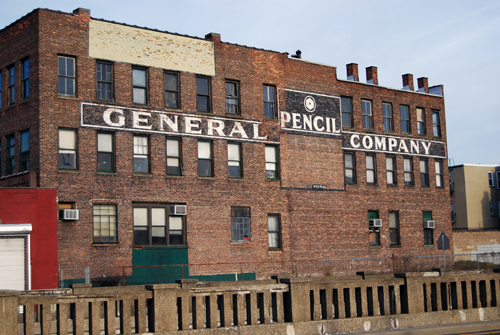
Fading signs

General Pencil Company, Jersey City. ©Frank H. Jump
I ran across an interesting blog about fading signs called Fading Ad Blog. Besides finding a couple of good New Jersey and New York signs (see above), there are a whole host of images for inspiration. If you are really interested, the author Frank Jump also has books called Fading Ads of New York and Fading Ads of Philadelphia in hardback, paperback and Kindle. I'm going to check them out.

*Edit* As pointed out by Frank in the comments, it is actually Lawrence O'Toole's Philadelphia book in the Fading Ads series, which now includes a Fading Ads of Birmingham. A great resource for modelers and excellent reference and/or entertainment for anyone interested in signs, history, business, architecture, cities, graphic design, etc.!

Friday, April 22, 2011

Courthouse Part 3

So I finally got to see the McClennan County Courthouse in situ at the Mayborn Museum at Baylor University in Waco. I was on the way back from visiting a client in Northeast Texas, and I was able to take a few minutes to make a half mile detour from the interstate to see my handiwork from several years ago.


The layout is in a high traffic area of the museum and gets lots of attention. I was a little surprised by the size - I had expected it to be a lot larger and stuffed into a room of its own. Instead it is small-ish and free standing so you can walk all around it. Separate loops allow for continuous action on different levels. As it turns out, I could have made the Courthouse a lot larger - to actual scale. That's a little disappointing, because I had created scale drawings from photographs to start with, then was told to make to particular reduced dimensions. A larger model would have fit fine, and it would have been a real show piece. I think it looks good as it is, and it kind of fits the more cute/toylike oeuvre of layout and museum overall. I think it holds up well as a representation, but I would like to attempt a more faithful scratch building project that is more about precise. All in all, a good project, good results, and I think it fits and adds to positively to the layout.

Saturday, July 18, 2009

A couple of N scale structures for hire

I've got a box full of structures to complete for a client in the next few weeks, and I've finished the first two. Both were very nice kits that were easy and enjoyable to put together.

Weighhouse

The first is a British weighbridge hut by Ratio Plastic Models. Everything fit well with almost no fuss or bother. I spent almost 2 hours painting the less than one inch long shack with several different colors. A base coat for the stone walls and concrete for the lintels. Then some individual coloring of the stones to provide a non-patterned multi-chromatic wall. I used a brush with about 4 bristles for that. Then a white/cream wet wash for the mortar and some fun with black and earth for weathering and finally some touches of green moss growing around cracks and corners. The roof has a base dark green slate and heavy black weathering. The brass details for door and window were lightly weathered, but the gutters have standing blackish gunk in them.

The other structure is a laser cut wood icehouse from Branchline Trains. Fantastic kit with tight fits and no sanding and very little clean up of parts after picked out of the wood sheets. The 3M backed details is a brilliant idea - I was skeptical before assembling - but in N scale, it makes attaching the tiny items much easier. The only problem I had was with the ladders because the cut outs were so small, they kept scattering and sticking to everything. Minor annoyance for such a nice kit.

IceHouse

I weathered up the tar paper roof a bunch since it is so large and visible to try and give it the same level of detail as the scribed wood siding. I love how the decking turned out after I applied a little antique oak stain from Hallmark Home Decor (from the craft store in a 2 oz squeeze bottle). I scruffed up the wood siding and dry-brushed the siding and decks to bring out some detail and weather them up a bit.

It was almost a full day of work building the two - mainly because of the painting and making a quick run to the hobby shop for supplies.

Tuesday, November 4, 2008

LDJ 39 is at the printer

I delivered (actually ftp'd) the latest issue of the Layout Design Journal to the printer late Sunday night. Good selection of layout types represented, with some great modeling as well as innovative ideas.

Unfortunately, the format of the issue has reverted back to a really ghastly newsletter template and associated primative graphics, logo, etc. that has been in use for 25 years. One of the main concerns was "large serif font for ease of readability by baby boomer generation". Interestingly enough, I just received a copy of the British modeling magazine, Narrow Gauge and Industrial Model Railways, and their sans serif typeface was smaller than that I used. Either the elderly British have better eyesight than we American old folk, the British modeling demographic is far younger, or this is actually just a red herring argument for those that can't wrap their head around anything different than they already are familiar with.

Friday, June 27, 2008

Courthouse Part 2


Compromises for compression and time


A couple of detail shots of the courthouse reveal some great classical motifs. This stone work with the architrave, engaged pilasters and Corinthian columns are fantastic - but hard to carve in a reasonable amount of time. The model has always been thought of as a background piece that lends flavor to the museum layout, so I swallowed my fanatical tendencies towards exactitude in design and execution in order to get the model done without going any more crazy than necessary.


So the main features with as accurate flavor as I could get out of a chisel was the goal. A student of mine started the process on the side panel doing a tremendous job at transferring the depths of the original to the scale model. She nailed the overall feel of the detailing so that there was no doubt what the building was, even though several bays were omitted and prominent details like the capitals had to be generalized.


Tools


A jewelers scroll saw and wood hand saws were used to cut the blocks of Balsa Foam to size. (A piece of cardboard was used as a drop cloth to make cleanup easier.) I used several different Dremel tool bits to grind down the major shapes, and smaller carving bits to do some of the details. Chisels were employed to make the cuts and evacuate material for the relief items like the windows and pediment as well as various dental picks and odd tools that had different sized pointy ends. A metal ruler was used as a guide to scrape the straight lines of the rustication and main features with a sharp pick.The detailing in the architrave was accomplished by cutting a round wood dowel in half and sanding to size, then just poking the end into the Balsa Foam (see below). The image above shows the two stages of doing the side walls as well as the roughed out dome.

I jumped in to complete the model after the first side was done, and tried to do as good a job as my student. (I came pretty close, but I think her efforts were better.) Her side is shown below:


Messy work


As you can start to see in the lower left of the above image, working with Balsa Foam is pretty messy. The material is very fine and the shavings are powder, which means they float around like orange dust. Wearing a mask when doing any sanding is a must, and don't have a fan blowing on your work surface. There is still a fine layer of this orange dust covering everything in my workroom, and it will take some time to get it off all the books, and equipment in the room. It cleans up really well, but you should wipe any metal objects fairly promptly to keep it from rusting. I had to sharpen the chisels once during the process because of the grittiness of the material. Next time I plan on using some plastic sheeting hung from the ceiling around my work area to keep the dust better contained.

Handcarved Courthouse Model Part 1

McLennan County Courthouse

Custom model for the Mayborn Museum in Waco, Texas


I was asked by a friend of mine to construct a model of the courthouse for an HO scale model railroad layout at the children's museum in Waco, Texas. The layout depicts Waco, and has several loops of running trains with representations of several of the buildings in town. The courthouse, which would measure about four feet long at actual HO scale, had a spot of about 11 1/2" x 8" reserved for it. Heavy compression led to a caricature model, as I call it, that has all the elements of the original courthouse without the heavy footprint. A perfect strategy for layouts on a diet.

drawing

First a drawing was made of two faces, the front and a side (shown above). This was done in Adobe Illustrator by tracing over a photograph and then scaling it down to fit the footprint. The third of three sides was the same except for the addition of stairs and an entry door, which was added on the fly without a drawing. The fourth side is left open, as the model will be up against a backdrop about 10 feet from the viewer. This was then overlaid onto a 1" thick piece of Balsa Foam II, and the drawing transfered with a pounce wheel. The Balsa Foam can be acquired from Dick Blick's art supplies among other places. It is a Phenolic foam which has no memory characteristics and will hold an impression so it can be "dented". It is flame retardant and self extinguishing - just in case. It accepts all water based and most solvent based glues and paint finishes, and it comes in several hardnesses depending on your application. I used the 12lb density, but next time I will try the softer 7lb density, which should make carving easier.

Next posts will show some progress shots and discuss techniques used to carve and finish the Balsa Foam.