Showing posts with label Layout Design. Show all posts

Saturday, February 21, 2015

On the Relationship of CVs, Thesis statements, and Place

HBS 700 cleaned up and ready to tackle the mean cobblestone streets of Hoboken, NJ.
A recent long email thread between modelers in Kansas City and Austin has centered around CV settings for realistic operation of locomotives. The concern has been to accurately set momentum, braking, and sounds properly to achieve the feeling of running an actual locomotive. This feeds directly into a running conversation among several of my modeling friends about the central organizing principle of layouts, or the thesis statement, that governs decisions about the construction and operation of a layout. Like anything in life, I believe having a central conceptual basis, or reason, for what you are doing with your layout makes your endeavor more cohesive, focused and helps it communicate your vision and intent more clearly.

I will concede that a majority of modelers may believe that a rigorous conceptual basis for a model railroad takes the fun out of the pursuit, because the enjoyment comes from doing whatever seems like fun at the moment. I can not stress enough that I have no problem with spontaneity and undirected play at all as a fun way to practice model railroading. (See my Fall 2013 LSR Marker Lamp editorial in vol 59, number 4 where I talk about modeling to escape versus modeling to engage.) But, suspend your disbelief for a moment if you think that modeling to engage sounds too much like work, and please think of it as just getting really involved in playing.

A huge part of any game and even undirected play involves a set of rules, or constraints, that make the game more fun for everyone, even if you are the only one playing, because how are you going to know what you are doing or if you are doing it well or not without rules? For me, having that central organizing principle or thesis statement is rule number one. Without knowing what I am setting out to do, how will I know if I do it or not? There may be several types of theses possible, but I would say that they are all sub categories of a very large catch-all bucket of categories that involve the idea and communication of the qualities of place.

On my layout, I am still developing my thesis, but the trajectory has something to do with conveying identity and the relationship of customer and railroad. Being a short line railroad, the Hoboken Shore had intimate interaction on a daily basis with its customers. My questions for this are, how could one model this closeness, and how can personalities come into play? On the Waterfront, which was filmed along the HBS right of way, provides an excellent example of the turmoil and roughness of the moment in time of the environment surrounding the HBS. I'd like my layout to impart some sort of understanding of this, and what it may have been like to work on a railroad in that particular place. Because of this trajectory, it becomes necessary to focus on the operator as individual within the context of 1950s Hoboken. 

The HBS was already waning on the heels of its busiest time during WWII. There must have been a malaise settling on the town and railroad as things were falling apart all over the Mile Square City. The mayor owned the local garbage collection company, and when decisions weren't made to his satisfaction, he refused to pick up trash for several weeks until the decisions were reversed. Graft, corruption, and general New Jersey politics led to empty buildings, dirty, malnourished children roaming the streets, and general hard times while the rest of the country was enjoying a post-war boom. It was so bad, that the mayor enacted a law that made it illegal to photograph the city during this time.

Capturing the idea of a place is a topic of an excellent blog post entitled "Power of Place" I read recently from Mike Cougill at his OST Publications blog. In it he explores the notions of place and the challenges of modeling them on a layout. He says,"in modeling, we give scant notice to how the railroad and community grew together. We only give a cursory acknowledgment of how the railroad fits the landscape and in turn, is shaped by it." We do tend to become fixated on the stuff and techniques of the layout instead of the overall effect we are trying to achieve. A 'can't see the forest for the trees' sort of thing, but I believe that creating an idea of place is the central reason behind creating any layout.

The place of Hoboken in 1959 is what I am modeling, so what does locomotive sound have to do with this? Simply and directly, the pace of operation for switching multiple industries in an urban setting is necessarily slow, so I want to make operation about the little things that were apart of the everyday movement of goods and products around the waterfront. This was what the railroad crews had, everyday things in small quantities that made up their entire lives. No varnish whizzing by at speed, no thundering Big Boys belching steam, nobody to really notice what was going on except for the people they dealt with everyday at the coffee factory, the shipyard, and the piers. The world was a small one connected to the globe, and it was these individual sounds that made up the ebb and flow of the aural scenery. 

It is easy to get sucked into tweaking CV settings on a locomotive just for the sake of getting the sound right. My driving interest, though, is to provide user feedback that makes prototypical operation easier and more enjoyable for the operator on my layout. Keeping this in mind while performing a seemingly isolated task of CV setting is important to me.

So hearing the small, but can-do nature of the revving of a 44-tonner before it moves is modeling the character and the reality of the Hoboken Shore Railroad. It wasn't glamorous, it wasn't pretty, but it was specific and part of the everyday experience of the individuals of the railroad, and that's important in supporting the thesis about the place that I am recreating on my layout. This small sound detail directly helps the central conceptual basis for my layout to communicate the particular place of Hoboken, NJ and how the railroad fit into it. For me, this makes for loads of fun, even though I am focused, rigorous and deliberate in my play.


More

For a great example of a strong, central thesis, see the layout of Jim Senese of Tulsa, OK. He has a clear intent for operators explore the interaction of multiple railroads with differing personalities on his "Kansas City Terminal RR" layout in Model Railroad Planning 1998.

I think place is a great topic for further exploration and conversation. I'd like to hear from you if you know of modelers who make place an important part of their layout.

This first appeared in Vol 61, Number 1 of the Marker Lamp.


Saturday, March 22, 2014

Apocalyptic Perspectives and Dystopian Dioramas


Model railroading can be a lot more than an escape from everyday life. It can be a method of understanding and exploring much more challenging situations and conditions of our world. A rarely taken trajectory in modeling is the depiction of dystopic scenes of dark realities.

I came across the first of a handful of darker dioramas some years ago. It is the work of a Yale architecture student (probably graduated by now)  Peter Feigenbaum in his Trainset Ghetto installation. Plenty of graffiti and trash in a rough contemporary urban scene. The lack of scale figures makes it even more foreboding and bleak.
Bleak, barren and broken.
What do we get from modeling a gritty, non-romantic area of urban blight? Maybe it has to do with a deeper, more real, feeling of reality. The dark and ugly are often more vivid and touching events in our own lives that perhaps provoke much more emotional stimulation than the joyous occasions. This is definitely not a normal trajectory for modelers, but I suggest that it is just as satisfying, if not more so, than modeling the sentimental, happy, idyllic scenes of our childhood or romantic notions of better times past that are more fiction than fact. Peter's dirty reality is not the only one I've stumbled upon that plucks at the grim emotions of uncomfortable situations.

Thomas Doyle is another artist who uses scale modeling as his medium to explore difficult and transformational events that are often less than happy scenes. His artist's statement indicates he is after those deeper emotional moments.
My work mines the debris of memory through the creation of intricate worlds sculpted in 1:43 scale and smaller. Often sealed under glass, the works depict the remnants of things past—whether major, transformational experiences, or the quieter moments that resonate loudly throughout a life. In much the way the mind recalls events through the fog of time, the works distort reality through a warped and dreamlike lens.

Another artist James Cauty is dabbling in the scale model railroading medium shows us an extended crime scene. Police, investigators and a general environment of mayhem poke at the establishment through nicely detailed work of architectural modelers. He wants us to consider our relationship to authority in a large installation. The 'layout' is,
far from the rural idyll of old model villages, Cauty’s diorama makes a political statement about societal freedom and state control.
Collateral damage from the getaway chase.
A description of the installation:
A motorcade brings the queen to view the scene of the crime.
Thousands of police swarm over a scorched landscape tattered and torn by rioting and looting, every window in every building is smashed, vehicles are overturned, bridges and roads destroyed, power pylons are down, a burned-out church still smoulders. Above this post-mayhem scene of destruction, helicopters shine their searchlights on the battered landscape. Above the helicopters, a train rumbles past...
These art works are designed to communicate a theme or some sort of meaning beyond just recreating a part of the world. They are all dark in some way, whether through the topic, the execution or the exploration of uncanny emotions. They are all by artists and not modelers. While everything we build communicates about the conditions of the building process, intentional, overt and explicit communication through models is what transforms the pursuit from a pastime to an art form (or a design form).

The above examples are nominally works of art simply for the fact that they were produced by artists for art galleries. What happens if model railroaders build layouts in their homes that create a recognizable message about society?  Are they even modelers anymore, and are they now, instead, artists? A quick search of the Internet reveals on the UK N Gauge Forum that this approach is being taken up by at least one modeler.

The forum participant, Mr Grumpy, is attempting to tap into the dystopian visions offered in such movies as The Matrix, Blade Runner and 1984. His N scale modeling is intended to portray the "divide between rich and poor" with skyscrapers built on "crumbling slums below." His layout is still in construction, but his exemplary video from Final Fantasy VII indicates it is definitely headed towards gloomy futurism:


Off the top of my head for my own Hoboken Shore layout, I have a couple of items to possibly explore grittier sides of the rough Hoboken waterfront. One is at Bethlehem Steel during the union strike of 1947 (as seen in the photo below) when almost 42,000 workers on the east coast paralyzed the ship building yards.

Picket line of Bethlehem Steel strike of 1947
Also of note are the extreme signs of poverty found in Hoboken at the time due to graft and corruption of Mayor McFeeley's regime. Garbage collection was suspended at a point as political retaliation, and the large numbers of out of work immigrant merchant marines and large population of poor children roamed aimlessly about the streets. Almost every other building seemed to be vacant at the time, with squatters inhabiting half-crumbled structures. An article appeared in the US Camera journal (in the collection of Hoboken Historical Museum web site) that illustrates the dire situation of the city in the 1940s. The entire article is interesting and posted in its entirety in their online collections.

From US Camera Vol IV, No.2
And equally ripe for dystopic modeling is the tough harbor life as seen in On the Waterfront with Marlon Brando, where apparently there were lots of longshoremen beating up each other. Far from the cute or funny scenes of overturned apple carts or skinny dippers normally found in a model railroad, I am contemplating these dark depictions to accurately portray how awful life was in this area of New York Harbor. It would be misleading not to model these scenes that were so important to the culture and environment in which the Hoboken Shore Railroad operated during the 40s and 50s. Certainly not the glamour and polish found in streamline passenger trains and glorious stations one more often sees in layouts and railroad press, but I wish to present a rather dirty, poignant slice of a hard everyday existence of which the railroad was a part.
Marlon Brando as Terry Malloy gets pounded by mobsters On the Waterfront (Horizon Pictures, 1954)
This is definitely an underrepresented niche in the hobby that occurs in isolated instances in a few layouts. I think both dark modeling and the broader genre of artistic modeling bear some more thought in the pages of this blog at some point later. Meanwhile, there are a couple of recent examples of prototype opportunities to explore darker railroading topics.

A common occurrence these days are (old) tank cars from the Bakken Oil Fields making their way precariously through communities across North America while pipeline construction is catching up to the new oil shale deposit production. This catastrophe happened in Lac-Mégantic, Quebec, Canada recently, when a train with 72 tankers full of crude oil is parked uphill in Nantes, and through a series of unfortunate events, ends up 10 kilometers away exploding and burning in Lac-Mégantic.

I have seen plenty of firefighters and fire trucks on layouts fighting car or building fires, but I don't recall having seen a model of a railroad accident. (Feel free to point me towards any examples in the comments section!) The discussion of dark layout subjects is simply to illustrate the idea that not all layouts have to glamorize what is in reality the very dirty, rough and dangerous business of railroading.


Another instance of a prototype event that seems to beg to be modeled for a contest model or RPM meet. From an email circulating through the railroad community:
CN train that hit a log truck on the Redditt sub (between Winnipeg MB and Sioux Lookout ON) at Sunstrum, ON (mile 38). Lead unit was the 5146 a GMDL SD40. Seeing the truck on the crossing before hitting it with the train, the engineer hit the deck below the window level and the head end brakeman ducked down behind the wall and door under the middle windows, that leads down to the nose of the engine. Both made it out alive. There was glass everywhere, the pulp logs loaded cross wise on the truck, penetrated into the cab including through the number boards.
Quite an amazing image, and equally amazing the crew wasn't killed. I haven't seen anyone tackle a modeling project such as this.

Why don't we see more modeling of disasters and unpleasantness? I think one answer is rather simple and straightforward: why would a 'normal' modeler want to spend a lot of time ruminating on a layout that was dystopic? That certainly couldn't be a happy retreat from the hassles and tragedies of everyday life, which is a big reason to have hobbies in the first place. I think that there is, however, satisfaction and respite in creating more challenging layouts with unpleasant or uncomfortable topics, and there is an equal sense of recreation to that pursuit.

There are also benefits for the final product of the layout itself, whether it is dystopic, idyllic or somewhere in between, if we approach creation of it from a more considered perspective of an artist or designer.

I believe that layouts that have a carefully conceived theme or thesis statement are generally better off than those that do not. In more general terms, and with dark and grittiness aside, there is a lot of room for layouts having identifiable themes and theses to be less craft-focused and more artistically focused. There are a lot of distinct situations available for such modeling found in many varied kinds of prototypes.

Getting the look of a railroad accurate is a technical pursuit, but getting the feel of the railroad is a more artistic endeavor. To be thought about more is why this more artistic approach would be beneficial, and how a rigorous thesis statement could help make decisions and provide productive focus for the modeler. It has everything to do with the process producing a better outcome. Simply put, it is identifying what effect you are trying to achieve beyond making a model look like its real life prototype. What is your layout's thesis statement? This may not be part of your current process, but it deserves a little consideration.

Speaking of process, I see that the glue is dry, so I need to get back to laying track.

Sunday, February 2, 2014

We don't actually like creativity

Disclaimer: Refer to my previous post about different modeling approaches and how there is plenty of room for all of us. I'm not trying to be disrespectful of others. I am just sharing how I feel.

And it is a lonely place. From a mathematical blog: http://easyquestion.net/thinkagain/2011/02/18/think-outside-the-box/


This is a personal reaction to an article I ran across in Slate over a month ago that hit me where I live titled, Inside the Box: People don't actually like creativity. It is a short piece that presents the phenomenon in this country where we celebrate imaginative people and where "viewing the world creatively is supposed to be an asset, even a virtue," but we actually have a bias against the ideas generated by that creativity. The referenced study reveals that people desire creativity, but reject creative ideas when we have a practical motivation counter to the creative idea. In other words, we like the idea of creativity, but not the actuality of it.

By day I am a mild-mannered architect and, until recently, teacher of design where I am supposedly valued for my ability to think and act creatively. As pointed out in the article, though, this is not what people really want from me. They want products that are a good-looking version of what they already know and are comfortable with. Something they have seen before that doesn't challenge them, something that doesn't stick out, something that is acceptable to others because that is what others have.

Oh, they will say they want you to 'think outside the box' (the phrase I hate the very most hearing), but what they really want is for you to be good at replicating what is already in the world. And, after being in model railroading for almost 40 years now, I have learned that model railroaders are people, too, and the same applies in this hobby world as much as it does in the real world.

The lack of risk-taking in the hobby has and will always surprise me, but I now have a tenuous grasp on the situation - at least enough of one to be able to better handle the situation. In general, people like recipes, solutions and 'right.' They don't like messy thinking, trying several iterations before being satisfied, or uncertainty. The want to 'know' how to do something and not to figure out how to do something new. As a consequence, I have gone from an exuberant young hobbiest throwing out ideas left and right to any and all who ask, to a much more cautious encourager of different approaches to a problem, to a reserved and reluctant adviser. I'm not happy about this change, but it is a survival skill learned the hard way.

As a designer, I was taught to respect the past, but not to replicate it. I am always looking forward, re-designing old things, looking for new problems to solve and trying to improve on any and every situation I come across. 'Progressive', 'new', and 'innovative' are the watchwords of the designer. Being creative is not an outcome, it is a different way of living life. It is a process and not a product. But it makes it difficult to relate to others at times, and it is almost always exhausting, especially when nothing comes of it. This happens in life, and equally unfortunately, it often happens in model railroading.

I used to offer 'creative' ideas about layout design to any and all that asked. The way these encounters go is that there is general discussion about "doing something" to a layout - be it scenery, track arrangement, fascia design, operating scheme, etc. This is like a form of crack cocaine being offered to a designer.

What happens is that my objective brain begins to shut down. This is the part of the brain that comes up with all the inhibitions and all the reasons not to do something. It is the logical, linear and doing part of the brain. It shuts down so that the subjective, free-associating, abstract and creative part of the brain can get some breathing room to do its thing - come up with a new idea.

So, my eyes get big, my pulse quickens, the world starts to slow down as the ideas speed up. I am in the zone. I ask innocently, "what is it that you are really trying to do?" A sharp first question is almost always devastating. "What do you mean?" is the usual response. I probe more. "What kind of mood are you trying to present? Do you want grandeur, intimacy, ruggedness?" Now I've got them thinking in a different way. It is not about finding the solution anymore. Our conversation is suddenly now about defining the problem and figuring out a desired outcome. Not until that is set will we concentrate on 'solving' the actual problem.

"You are talking about "x", but it seems like "y" is the problem if you are trying for that effect," I say tentatively. "You're right!" they say with surprise. "Then what if we did..." and we are off on a brainstorming adventure that comes up with many 'outside the box' (cringe) ideas. It is an exciting conversation, and it often lasts for several minutes. Or even hours, because once you are in the design thinking zone, you are looking at the layout in a totally different way. Suddenly that initial 'problem' transforms into a multitude of 'opportunities' to apply the same conceptual idea thought of for the original. Now everything is falling into place. Every decision about the layout relates to a central idea. Every decision becomes easy. Everything now makes sense.

Then the logical side wakes up in my conversation partner. "That's nice, but nobody builds a layout that way," he says suddenly aware that he has left the comfort of everything he has ever seen in a model railroad. "So?" I reply innocently shrugging my shoulders just the slightest bit. "Those are really creative ideas, but I'll have to think about it." And with that I know that nothing we talked about will ever happen.

I can't begin to count all the times that scenario has played out in front of my eyes like a car wreck you see unfolding in front of you with no power to stop it. It is a horrible feeling. It is the crash after a drug-induced high. Over the years the highs are not as high and the crashes are not as hard since I am pretty well desensitized, but it is still something that I actively avoid. I try not to think creatively when I am around (most) model railroaders - it's not what they are actually interested in hearing.

There are still the inquiries for advice. After editing the Layout Design Journal where I tried to do something different and was rejected, I get several inquiries from people who are looking for creative ideas. What they are actually looking for, though, is the 'right' answer - the answer that others have done before. Yes, there are good general rules of thumb like any endeavor, but there are also a universe of new ways of interpreting those general rules. For a while I tried to vet people to make sure they were looking for creative ideas - testing them, asking if they were really sure they wanted a creative suggestion, and they always said "yes", but they always meant "no." I don't try to vet anymore. At this point, I either just do what they have already decided is the right way or decline to help.

I have learned to adapt so that I can have fun, and it has worked out pretty well. The stress of trying to convince people to look at things a different way is gone, the disappointment and awkwardness in others' reactions is gone, the feeling of being a weird outsider is gone. I can now blend in and back slap everyone on what they do and not have to explain my crazy ideas. Perhaps I can sneakily get others to design rather than just do, but for the most part now, I try to enjoy other peoples' approach to the hobby as they enjoy them and not how I would enjoy them. Kind of a Zen approach to the social aspects of the hobby. A passage in the book Chuang Tzu reads, “flow with whatever is happening and let your mind be free. Stay centered by accepting whatever you are doing. This is the ultimate.”

I've found a couple of people in this perhaps yet undefined niche who really like to design what they are doing rather than just do what they are doing, and I follow their work, and we have great conversations. Some call it 'thinking man's' pursuits - I just call it designing. I'm hoping to find a few more of these types of modelers and maybe put some of our thoughts together in a publication.

The point of having a hobby, though is satisfaction on your own terms, in your own time and place. My terms happen to include re-thinking what to do and how to do things versus doing them like everyone else already does it. Or more succinctly, I like to design.


Friday, April 12, 2013

Voice modeling

"Morning, Bud. This is Hank down at the Maxwell plant..."
Trevor Marshall just posted a nice entry on his blog about operations. In particular he discusses the possibilities of modeling the time it takes to do brake tests per car and how that helps to slow down operations. The key, in my opinion, is to provide interactions to simulate activities. 

These provide the operator continuous 'doing' activities and should entail some sort of feedback component to 'reward' the behavior. I would love to see a throttle that had a button labeled 'brake test' that could account for number of cars, etc., and provide feedback sounds of compressor, and an "air test OK" voice reply when done. The possibilities are numerous. This could be easily modeled if one used a mobile computing device as a throttle through JMRI interface, but I would prefer a physical throttle that had such things programmed into it. 

Along the same lines, Tom and I have started brainstorming something like this for customer interactions with the railway agent/dispatcher on my layout. In particular, the idea that a customer calls the agent when a car is loaded or unloaded and ready to be moved.This would be triggered by a timer started when the car gets spotted, or via a random call generator during a session.

A pre-recorded voice of an 'actor' (probably not officially affiliated with Screen Actors Guild or any other professional organization - in other words, me) would say something like, "Morning, Bud. This is Hank down at the Maxwell plant, and we need an extra box car today for a special order." The agent then writes up a waybill and/switch list for the locomotive crew combined with previous calls before the call time and off they go. At the plant, a crew might also get an earful from Hank telling the story of the fish that got away while they are trying to secure the brake lines for that special delivery box car, and they can't leave until he is finished.  

On a very short line (1.9 miles) like my Hoboken Shore RR, customer interaction was an arguably more direct personal component of everyday operations. Having the voice of a particular customer letting you know what needs to done provides prototypical modeling and operational interest. What you model all depends on what you think is interesting about railroading.

Tuesday, July 31, 2012

Dynamo article in LDJ-47

It's hot from the printer's - go get it! (and join the LDSIG so that it shows up in the mail like magic every few months.)


  • Planning the Newcastle-Fassifern Railway with LDEs
  • Improving a Classic John Armstrong Plan in N Scale
  • The Continuous Model Railroad: More Railroad than your Room Can Hold
  • Proto-Freelance Midwest NYC Layout Inspired by Published Plans
  • Weighing the Scales: Experienced Multi-Scale Modelers Discuss Pros and Cons
  • Benchwork and Fascia Ideas from LDSIG Tours
 … and more!
Download a free sampler of pages from this issue.

Tuesday, May 22, 2012

Erie Dynamos in N Scale Part Deux

For the first part of the Continuous Model Railroad, see Erie DYNAMOS layout in N Scale

Applications (continued)

So let's apply the dynamo principle to the Erie Railroad. First we need to gather the prototype's track charts. We need the charts to know what the track alignments are in order to figure out our module requirements and configuration. The first chart on the Erie's east end is the Jersey City to Carlton, NJ that includes the large Croxton Yard complex. This covers the first 9 miles of the eastern end of the line.

The black blob is Croxton Yard between Jersey City to the right and Carlton, NJ on the left..

The next section takes us from milepost 10 at Passaic Park to Hohokus and mile 22, but we are only going to be able to make it to Paterson, NJ at mile 15 in the first session. Now we can look at the track arrangements and match that up to our stable of standard modules.

Part of the track charts for our journey to Chicago from Jersey City.


The classic model railroad problem is that we model railroaders want to fit 900 miles of railroad into 400 s.f. and Dynamos allows one to do that, just not all at the same time.
The space that I have to work with is a living room that measures about 16' x 20' which is convenient for a standard 2'x4' (or 1'-6"x 4' since this is N scale) module with 4' aisles. Included in each session will be staging modules at each end, so those will pretty much be set and all we have to do is fill in between. The corner and aisle turnback modules also end up being fixed for all intents and purposes since this is the best way of filling this particular size room in a traditional "E" configuration of modules. This means that all that will change from one session to the next are the 18 intermediate modules.
Our stable of standard abstracted Operational Design Elements modules
Module identification


The first session on the Continuous Model Railroad includes only modules "A" through "I" since we haven't hit the 4 track main line, yet, which starts at "WJ" tower at Ridgewood, NJ. In addition to the fixed requirements of staging (2 "H"s and 2 "G"s) and corners (6 "A" modules) we will need these quantities:"B" 2,"C" 1,"D" 4,"E" 4,"F" 2,and "I" 2. I would build the staging modules "H" on wheels to make getting ready for the next session a snap!


Session 1
How the sessions break down moving East to west. In retrospect, I might do the sequence starting in Chicago and moving west because there is a greater flow of loads moving East to NY. I could, of course, easily do this the second time around.
The next session sees only minor changes to the overall set up, only the names of the towns are changed. (This could be accomplished through a nice sign pocket on each module that allows for quick re-naming between sessions.) Session 2 will move us from Paterson to Suffern.


There are only six modules that need changing in this session. Shown with the red dots in the next figure, the major change is the addition of another yard at Allendale between Paterson and Suffern. Now sharp Erie railroaders will be cringing at this point, because I have been showing a two track main line in places where there should be four between Rutherford and Suffern. I honestly don't remember why I didn't do this when I originally presented this idea at the Tulsa LD/OpSig event a couple of years ago, but I can perform some post-rationalization at this point and say that it didn't make financial sense to build so many four track main line modules to only use in this session as almost all of the Erie was not four track main, or maybe I simply messed up.
Only a few changes are necessary for the second session.

Operations

It is now a matter of getting out our employee schedule to start working up our operating scheme for the sessions.
The part of the schedule that corresponds to the Session 1 area on the system map.

The Westbound schedule from Jersey City to Port Jervis that includes what we need to know for operations in the first few sessions.
Almost all of the trains run daily, so it doesn't really matter what part of the week simulate. I would choose a particular day to start off with, though, so that we could keep a consistent timeline going as we move across the country to make the experience more relevant. A little research will tell us what these trains are and what the normal consist would be. Moving westbound, a lot of the trains will contain empties moving back into the heartland where goods consumed on the East Coast are manufactured or grown.

So what gets interesting is how you set up the sessions. There are several possibilities, of course, and it depends on what you are looking to get out of the experience in order to determine how to craft the operating scheme. If one were interested in a particular train, one could operate a very slow clock and model only a couple of hours in each session so as to follow this train from end to end.

The Erie Limited, train No.1, for example, departs Jersey City at 9:30 AM each day, so operating the schedule from 9:00 AM to 11:00 AM the first session would see this train move from East to West and arrive at Patterson. In order for the next session to be properly aligned in time, No.1 would start at Paterson and the session would again start at 9:00 AM, because No.1 moves through Paterson only a few minutes after leaving Jersey City. In fact, since it makes no stops, No.1 is scheduled to depart Goshen, which would end up in our 4th session, at only 10:49. This means that the first FOUR sessions we hold are all modeling operations between 9:00 and 11:00 AM on one day.

During this time, however, all sorts of other activities are happening with locals, through and way freights doing their work. Since we are shifting our focus from East to West, we would see the same locals operate in the same direction each session. This would happen with the eastbound traffic as well with their entrance to the layout occurring a few minutes earlier each session until they no longer show up within the time frame set by our following of the train of our interest, No.1.

What is fascinating about operating the Continuous Model Railroad in this manner is that the trains operating during a given session would largely remain the same from one session to the next, as would the time. Differences would be small and mainly consist of when the train moved through the layout. The larger difference would be seen in the shifting of the towns from one session to the next, almost as if they were standing still and the layout were moving underneath them.

Another way to organize the operating scheme would be to model an entire day before moving on. This would place emphasis on the location rather than a selected train. This scheme would allow for an appreciation of the rhythm of the place, rather than the experience of the train. The understanding, then, of the whole trip from New Jersey to Illinois would be more about the patterns of the entire Erie Railroad. Appreciation is gained of busy commuting trains punctuated by a named passenger train or express freight and how this is mapped onto a daily pattern of traffic on the railroad.

By following a train across country as in the first example, the appreciation is centered on the experience of movement, not on the experience of place.The constant is the train - everyone will be focused on when the train is present in relation to the location. Time then becomes the measuring stick. It is as if we see the train as a second hand passing each city which is a number on the clock face.

Shifting the focus around by modeling an entire daily cycle in one location, the reference is switched from following a sweeping second hand of a clock to a static orientation based on where you are and gaze upon the face of the clock where a particular number is being passed by the clock hands. The same schedule and operations routine of a prototype railroad can then be experienced and understood in two completely different ways using the same layout space. 

Different understandings of a railroad

This is the crux of the whole idea of the Continuous Model Railroad: through the abstraction of space (the transformation of track arrangements into dynamo ODEs) and the ability to swap them around interchangeably (the Dynamos modular system), we are able to bring focus onto the temporal component of railroad operations, and because of that, experience railroading in a completely different mode than we are accustomed.

This shifts our perspective from the current practice of representing an entire railroad through a single specific instance to understanding each location of a railroad in relation to how the entire railroad operated. This effectively reverses the adage that we can understand the whole world through a single grain of sand to understanding each grain of sand by looking at the entire world. A microcosm representing the universal or the universe explaining the microcosm? The flexibility of Dynamos sets up a duality where you have a choice between the two, but you should really try both for the most complete understanding of the operations of your chosen railroad.

Module construction

I have been working on developing a lightweight modular system for a while now, but I don't have an ultimate proposal as of yet. A recent NMRA Magazine article described an aluminum angle and Masonite method that is similar to my thoughts. I've been looking at aluminum shapes, but I have not decided on the skin component. I've looked at honeycomb cardboard, Gator board and regular building insulation foam among other materials. I am leaning towards Gator board at the moment.

The other part to consider is what the modules will sit on. There are several examples out there from Freemo, Ntrak, and other module systems. My priorities include lightweight, ease of set up and tear down, and finally storage space required.

I would use standard code 80 track with manual switches. No need to complicate anything for modeling realism that might compromise operations. No layout is fun if you have derailments or power problems, so the simpler the better in this case.

Proof of concept

I guess the next thing for me to do is to actually try this. We all have good ideas, but do they mean much if we don't try them? I believe it would prove to be a worthy distraction from the Port of New York layout, but I don't think this will translate into HO, so I can't use any of the equipment I already have. I'm not sure I can justify this divergence of funds. I've only got a handful of N scale equipment at the moment, but maybe I could simply lease what I need. This is what the prototype would do...

If you are interested in hearing more about this, I have a slideshow of the presentation I made at the Tulsa convention.

More on the Continuous Model Railroad as it develops...

Tuesday, May 8, 2012

To (and From) Russia (on Trains) with Love

Sounding like a 19th century Napoleonic missive (see the history of the idea to build the Chunnel between Britain and The Continent) there is talk about building a tunnel in the Bering Strait to connect the US with Russia by rail.


The proposed connection between the US and Russia via inter-continental rail


This is quite an idea, and it, too, was thought about long ago (a musing of Czar Nicholas II in 1905), but the economics of it are apparently now ripe for the actual mission to take shape. Seems the Chinese are also keen on this, and with three of the largest nations on earth all thinking about doing something, it just might happen sooner than later.

I'm certainly excited by the idea, and I might start saving my pennies to take that train trip (although in reality it would probably be miserable as a passenger and more exciting and easier for a piece of freight to be shipped to me "ground service" from China). This could mean a whole new category of rain service - the ultra-long distance freight express.

So my question is, naturally, how could one model this new ridiculously long route? It would be a great candidate for the continuous model railroad Dynamo concept, of course, but what other ways might this vast and frozen route be tackled? I'm feeling a little silly at the moment, so I might take on the tunnel itself.

"What on Earth is this guy thinking?" Well, I'm thinking that the most important signature element this railroad has to be the bridge and tunnel system that gets the railroad across the Bering Sea. Viewed as either an LDE (a layout design element) or an ODE (an operational design element), the tunnel layout would not be a John Allen subway line, but rather more like an Iain Rice portrait layout that captures the essence of what the railroad is at that point - under water, probably going quite fast, and cold. Some interesting things to model.

A cross section of the proposed Bering Strait tunnel. How would this translate into a model railroad?

Capturing those elements would be a fun challenge. Imagine a layout whose backdrop was actually more of an overdrop extending down from the valence and right in your face. A model of a cross section of frigid ocean water and life would be quite stunning. Then below the very narrow strip of train tunnel at eye level would be a think cross section of sand, rock and earthen modeling that would make for an unusual framing for a railroad. The trains would move fast (who wants to slow-poke it through a mulit-kilometer underground and undersea hole), and they would probably be container trains. Maybe a new type of container for this different sort of trip? I would think the  locomotives might rate a new look and functionality as well - perhaps ones with sleeping berths and extra fuel compartments integrated into them?

Such a layout would be future-projecting, which doesn't happen much in model railroading. Most of the alternate realities are simply freelance or what-if railroads whose validity comes from being as believable as possible to fit into an existing context. But there are not many (any? Tell me about them if you know of one!) that are set in the future? What happens to the hobby activity when it becomes speculative (like a freelance railroad) and also forward-looking?

The modeler would necessarily become more like a sci-fi author/designer having to extrapolate and extend the railroading of today into a future setting that has new constraints and needs to be designed for. What a great opportunity to experiment and play with scratchbuilding new locomotives, liveries and specialized rolling stock. The scenery would be out of the norm, the presentation unusual at least, and the demand on creativity very high. Might be a good challenge for someone out there who has mastered recreating railroads from memory or research, and who is up to the challenge of designing a railroad mostly from sheer creative vision.


Saturday, April 28, 2012

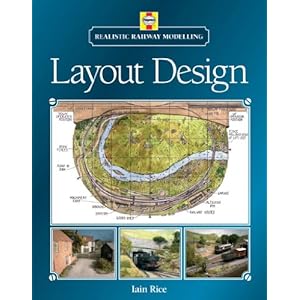
Book Review: Layout Design by Iain Rice


The first book in a new series by J H Haynes & Co, Ltd, Realistic Railway Modeling, is Layout Design (2010) which is as much a slice of philosophy as it is a hobby guide book. Written by prolific British author Iain Rice, the tone and flow of this book is informal and smart, and promotes a particular approach to modeling that is informed by the author's artistic schooling.

This 176 page hardback retails for $34.95/£25.00 and is presented in a clean, color-coded scheme with sans serif typeface that moves from overall philosophy and approach to the hobby through "Boring Bits" and the "Things You Can't Ignore" chapters to the heart of Rice's argument in the "Visual Design and Presentation" chapter. Only after all these have been rightfully considered along with prototype research, logistics and operational considerations does he address the actual plan for your layout. He notes in his "Preliminaries" chapter that the track plan has traditionally been held as "the only blueprint needed to build a model railway." 

Not so, as Rice argues for a more complete and holistic method of design that resolves all issues of the layout from the perspective of finished product. He puts forth that design considerations must involve viewing perspectives, operational desires, visual harmony and proportion as well as the nuts and bolts of the construction. The artistic elements are where he places emphasis, and the rest of the pieces are supporting cast to achieve his goal of a realistic model railway - including the track plan. The effect of the layout as a whole is the prime motivator.

I could not agree more with Mr Rice about designing holistically. Too many times I have consulted with clients and friends over track plans. Too many times I have tried to get them to think in these holistic terms, only to be humored for a few minutes before turning back to the track plan as the central organizing principle of a layout. It could be that people are thinking of the track plan as the plan view for the layout. I believe it was Mies van der Rohe who promoted the primacy of the plan as a generator for good architecture, but he was after different overall effect than a model railroader. 

Mies was organizing space to be experienced from within. Adjacencies, relationships, proportionality and materiality were key ingredients for the experience of an inhabitant. While all of these ingredients are also key in the development of a model railroad, the viewpoint of the experience is almost completely exterior to the space itself. It is much more akin to a painting or sculpture than a work of architecture. The arrangement of ingredients must be thought of in terms of the gaze and not the experience of being in a three dimensional space. So in model railroading, the track plan must be considered an ingredient, too, and not the primary organizing element. The better method of organizing space in a model railroad must be in something more like the perspectival vignette sketch that allows for the understanding of the visual relationships of the different elements in the layout. 

It is not surprising, then, that Rice's main graphic tool for developing and communicating his layout designs is the perspective sketch. His signature sketches - usually rendered in color -  allow him to consider the placement of buildings, roads, landscape, backscene, and tracks as an entire composition for a holistic design approach. 

In the "Visual Design and Presentation" chapter, he shows that this sketching method for designing affords consideration of proportion, composition, viewing angles, scene division and visual balance. It is also a way to test out "sizes, mass and scale of objects and their placement in the scene." He suggests some basic techniques for this such as using the Golden Mean (or Golden Section) to find the appropriate boundary areas for locating things. All of this is to support his main goal, which he sets out in the introduction: to create a believable and realistic ambience of a prototype railway. 

Throughout the book, Rice includes many great devices for framing how one should think about layout creation by setting of parameters. His first parameter is to set a general approach of "compromise and deception" to achieve the desired ambience. Then, in order to create this ambience, one must nail down underlying motivations to arrive at a guiding mission statement with which to evaluate all decisions. Using this approach, a layout practically designs itself - all you have to do is figure out the constraints and goals you have, then stick to them throughout all the rest of the decisions!

He explicitly addresses this in the chapter "Rationales, Lists and Logistics". He suggests using lists to help organize your thoughts and prioritize desires. Ironically, one of the few things I find missing from the book is a list of things to do while designing a layout as a way of condensing the whole book into an actionable guide for the reader. I would suggest making this list for oneself, starting with why you are even building a layout to begin with. 

I very much enjoyed reading Mr Rice's overall look at designing a layout. It is an easy read and well illustrated, presented and produced, and I'm looking forward to seeing more of this series. This is a great book, especially for the beginner who is wondering what model railway building is all about. As an intermediate or advanced layout designer, this can help clarify what you may already do, but give you more control over the process.

What I am left with is the interesting contrast in approach to modeling between Rice and many of the mainstream American model railroading authors. This is something that may be worth thinking about in the near future.


Friday, December 24, 2010

Erie DYNAMOS layout in N scale

Erie New York Division in N Scale

I've taken a stab at developing my Dynamos idea for the Erie Railroad from Jersey City to Chicago milepost by milepost. This first layout uses some standard modules developed from looking at the track arrangement charts for the Erie arranged to replicate the operating characteristics of the railroad instead of the physical characteristics of actual places. The first layout models the operations between MP 0 and MP 16.
An article I am working on explains further:

How to Model More Railroad than Your Room Can Hold

A layout design methodology for dynamic operating schemes

Terms: 
 Dynamos: DYNamic Abstracted Modular Operating System, Dynamo: DYNamic Abstracted MOdule

ODE: Operational Design Element. A typologically identifiable portion of a model railroad layout that is linked to the operation of the layout. A section of a model railroad that has a discrete (or particular combination of) operating elements such as an interchange, siding, yard (or separate yard element), passenger station, industry spur or spot. Can also be used for type of landmark or scenery element such as a bridge, tunnel, cut, roadway or other part of the natural or built environment that affects operations.

History
The hobby of model railroading has continually advanced in the areas of craft, manufacturing and technology since modeling became distinguishable from simple toy train activities in the early part of the twentieth century. For some hobbyists, the reason for modeling itself also has continued to evolve over the course of the last 100 years from simply being a quest for more accurate models and better looking scenery to modeling the railroad operations and prototype practices as more than a model of a railroad to more of a simulation of a railroad. 1

Layout planning has very directly been affected by this evolution in approach to the hobby. Most recently, forward-thinking ideas of David Barrow and Tony Koester have had a great influence on those of us who are striving for clarity, realism and operations-oriented model railroading. Two of those ideas, the domino benchwork construction and planning method of David Barrow and the Layout Design Element, or LDE, of Tony Koester have both shaped current discourse of layout planners and are particularly interested in the simulation, or game of model railroading.

If one were to combine the layout planning methods of domino construction and an abstracted form of Layout Design Elements, it would result in a dynamically flexible and effective system for modeling the operations of an entire railroad by allowing for continual reconfiguration of domino sections from one operating session to the next. Combining modified ideas of domino construction and LDEs results in a flexible and effective method for modeling the operations of an entire railroad by allowing for rearrangement and reuse of domino sections from one operating session to the next.

David Barrow used the term “domino” for a benchwork construction method in an article for Model Railroader magazine in 1995 and gives credit for the term to Bruce Goehmann who wrote about “domino” planning for traction layouts in a MR article in October, 1985. [Diagram XX] Related to Swiss architect Le Corbusier’s Maison-Domino, a basic building prototype for mass production housing with free-standing pillars and rigid floors that privileged modularity and clarity in architectural form and construction, the effect of domino planning on model railroading has been significant in that it reinforces the around-the-room, or shelf style layout that is sincere (the train moves through each scene only once maintaining the same direction).

In his own layout evolution, David has most fully taken advantage of the domino method of construction in a way very closely aligned with Le Corbusier’s emphasis on modularity through the re-use of benchwork modules in new track configurations as well as an organizational method during the re-design of new representations iterations of Santa Fe track and operations around Lubbock, Texas. (see MR XXX 2009)

What I take from the domino method is the ability to rearrange standard modules in the manner of NTrak or FreeMo in a home layout setting with a standardize dimensional relationship (such as the convenient 2’x4’ module Barrow frequently uses). In addition, Barrow, among others like Mike O'Brien and Tom Pearson, have been a part of a larger discussion about minimal model railroading (to the ire of many modelers who have said to Barrow, "that isn't model railroading"). The idea that photographs of a place or industry can be used instead of modeling a structure or scenery in three dimensions suffices for the purposes of modeling operations.

Bare plywood and Code 100 rail aren't even noticed if one is really involved in the operations aspects of a layout. David has tested this on us operators by replacing code 83 rail with code 100 rail on a section of mainline and then asking us if we noticed in the post-op debriefing session. Nobody did, because we were all intent on what we were doing with our trains and couldn't care less about the rail size. This changes, of course, when there is no operation happening and one is only railfanning. This boils down to which master you would like to serve: operation modeling or physical modeling.

The idea of Tony Koester’s LDE or Layout Design Element is to represent a prototype location as closely as possible in a modeled portion of the layout. [Diagram XX] His definition in his own words is,
a visually and operationally recognizable model of a specific prototype location, such as a yard, junction, industry, engine terminal, and so on. A scene that comprises elements of several familiar scenes or reminds one of a general region or type of railroad is not an LDE. It has to reflect the visual and operational characteristics of one actual location. The name can be changed, or even the structures (to some degree), but the physical layout cannot other than by the judicious use of selective compression. 2 email to author, dated XX/XX/XX

Operational Design Element
Generated from a series of conversations with Tom Pearson, an extension of the idea of an LDE could be an ODE, or Operation Design Element. Instead of striving to be an exact duplication of a prototype situation like the LDE, an ODE is an abstracted representation of a particular typology of a railroad’s operational situation (be it prototypical or free-lanced). An ODE is not necessarily directly representative of a specific prototype's location and situation, but it would be based on the practices of a particular railroad such as roadbed sections, color of ballast, signaling, sidings, etc.

Furthermore, it is a section of a model railroad that has a discrete (or particular combination of multiple) operating elements such as an interchange, siding, yard (or yard element), passenger station, industry spur or spot. The term can also be used for an identifiable type of landmark or scenery element such as a bridge, tunnel, cut, roadway or other part of the natural or built environment that affects operations. [Diagram XX]

Mark of a Dynamos layout design

Dynamos

What the combination of the ODE and the domino method makes possible is the ability to design a dynamic layout, or a layout that can be re-configured to meet a host of different operating possibilities. By using a standard position for track placement between modules like the FreeMo and Ntrak modular standards, one can create several LOEs using the same dimension domino module and reconfigure their arrangement to create different operating layouts without the need to relay track. This system is called the Dynamic Abstracted Modular Operating System, or DyNAMOS method of layout design.

There are several possibilities for taking advantage of the flexibility of dynamos. My own impetus for developing this idea comes from grappling with the necessity of “selective compression” in layouts juxtaposed with the desire to model an entire class one railroad, in my case, the Erie Railroad from New York City to Chicago. [Erie Schematic Map] With the re-combination of a set of dynammos that model a variety of typical main line situations of the Erie, one could model the entire length of the Erie by rearranging modules between operating sessions. Over the course of an extended period of time, it is possible to model the operations of the Erie’s flagship freight The Flying Saucer from Croxton Yard in New Jersey to Chicago over the entirety of the Erie main line all in a relatively small amount of square footage.


The “selective compression” of space becomes “selective sectioning” of space that is dynamically recombined across time to create an otherwise unmodelable scope of a large railroad system. In terms of operation, one could think of this as The Flying Saucer’s standing still as the layout moves beneath it since the train moves across the layout each session in the same direction. [Diagram XX]
One could also model different eras of the same portion of a railroad by merely dropping in the appropriate track arrangement for the given era. The double tracking of a section of the UP line in Cheyenne, Wyoming that took place in 19XX could be switched out to see how it affects operations or to match the modern equipment you have recently purchased.

The dynamos system could also facilitate modeling different railroads altogether. If one were interested in operations in New Jersey, for instance, one could model a multitude of railroads that connected to each other. If you were to take the area around the Erie operations in Croxton, New Jersey, there are several Erie branches and other railroads that connect o the yard. The Northern, Greenville Lake and Weehawken branches originate from Croxton, and along with the railroads of the DL&W, PRR, Northern, Susquehenna, NYCentral, NYO&W, LV, etc. there are plenty of tentacles that radiate from Croxton Yard to keep modeling new operations for many years while still remaining in the same immediate area. [Diagram XX]

Application
To make such a system manageable, one would need to use quick-disconnect cabling for power and DCC systems, a standard accessory arrangement for lighting, signaling, etc. and a construction method that allows for temporary, yet secure, placement of benchwork modules. One might look to the system under development by Ian Rice 3 that is attempting to standardize infrastructure arrangements, in his case so that one can reuse modules for completely new scenes and track arrangements. We would want a system that merely connected in a consistent and easily unplugable manner, and ideally would stack for convenient storage.

Construction out of lightweight materials would also be desirable for ease in handling. Metal and plastic structural systems could be used along with foam and other methods already employed by modular modelers.

For track configurations, one would need to generate a set of standard arrangements that were typical of a particular (or generic) railroad. A set might include:

A Corner
B Double track main line (with crossover)
C Double track main line xtra (with crossover)
D Main line with working siding
E Yard throat
F Yard Body
G Staging ladder
H Staging body
I Interchange
J Quadruple track main line end
K Quadruple track main line body
L Quadruple track main line body with industries
M Quadruple track main line with interchange 1

N Quadruple track main line with interchange 2
O Quadruple track yard throat
P Quadruple track Yard body
Q ?
R ?
S ?


Potential Conflicts

To keep the number of total dynamos relatively contained, one would need to make concessions on a few track arrangement issues. Whether a diverging route came off of the far or near side of the main, turnout orientation (trailing or facing), etc. An optimal number of modules would have to be arrived at considering storage space, concessions required, etc.
I'll update as this idea progresses. [See part 2]

References
1

2

3 Rice, Iain, Layout Design Haynes Publishing:Sparkford, UK, 2010, p 52.