Saturday, April 28, 2012

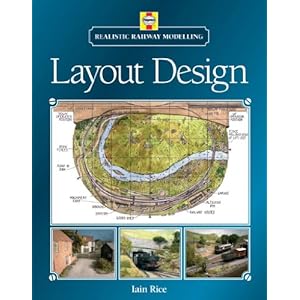
Book Review: Layout Design by Iain Rice


The first book in a new series by J H Haynes & Co, Ltd, Realistic Railway Modeling, is Layout Design (2010) which is as much a slice of philosophy as it is a hobby guide book. Written by prolific British author Iain Rice, the tone and flow of this book is informal and smart, and promotes a particular approach to modeling that is informed by the author's artistic schooling.

This 176 page hardback retails for $34.95/£25.00 and is presented in a clean, color-coded scheme with sans serif typeface that moves from overall philosophy and approach to the hobby through "Boring Bits" and the "Things You Can't Ignore" chapters to the heart of Rice's argument in the "Visual Design and Presentation" chapter. Only after all these have been rightfully considered along with prototype research, logistics and operational considerations does he address the actual plan for your layout. He notes in his "Preliminaries" chapter that the track plan has traditionally been held as "the only blueprint needed to build a model railway." 

Not so, as Rice argues for a more complete and holistic method of design that resolves all issues of the layout from the perspective of finished product. He puts forth that design considerations must involve viewing perspectives, operational desires, visual harmony and proportion as well as the nuts and bolts of the construction. The artistic elements are where he places emphasis, and the rest of the pieces are supporting cast to achieve his goal of a realistic model railway - including the track plan. The effect of the layout as a whole is the prime motivator.

I could not agree more with Mr Rice about designing holistically. Too many times I have consulted with clients and friends over track plans. Too many times I have tried to get them to think in these holistic terms, only to be humored for a few minutes before turning back to the track plan as the central organizing principle of a layout. It could be that people are thinking of the track plan as the plan view for the layout. I believe it was Mies van der Rohe who promoted the primacy of the plan as a generator for good architecture, but he was after different overall effect than a model railroader. 

Mies was organizing space to be experienced from within. Adjacencies, relationships, proportionality and materiality were key ingredients for the experience of an inhabitant. While all of these ingredients are also key in the development of a model railroad, the viewpoint of the experience is almost completely exterior to the space itself. It is much more akin to a painting or sculpture than a work of architecture. The arrangement of ingredients must be thought of in terms of the gaze and not the experience of being in a three dimensional space. So in model railroading, the track plan must be considered an ingredient, too, and not the primary organizing element. The better method of organizing space in a model railroad must be in something more like the perspectival vignette sketch that allows for the understanding of the visual relationships of the different elements in the layout. 

It is not surprising, then, that Rice's main graphic tool for developing and communicating his layout designs is the perspective sketch. His signature sketches - usually rendered in color -  allow him to consider the placement of buildings, roads, landscape, backscene, and tracks as an entire composition for a holistic design approach. 

In the "Visual Design and Presentation" chapter, he shows that this sketching method for designing affords consideration of proportion, composition, viewing angles, scene division and visual balance. It is also a way to test out "sizes, mass and scale of objects and their placement in the scene." He suggests some basic techniques for this such as using the Golden Mean (or Golden Section) to find the appropriate boundary areas for locating things. All of this is to support his main goal, which he sets out in the introduction: to create a believable and realistic ambience of a prototype railway. 

Throughout the book, Rice includes many great devices for framing how one should think about layout creation by setting of parameters. His first parameter is to set a general approach of "compromise and deception" to achieve the desired ambience. Then, in order to create this ambience, one must nail down underlying motivations to arrive at a guiding mission statement with which to evaluate all decisions. Using this approach, a layout practically designs itself - all you have to do is figure out the constraints and goals you have, then stick to them throughout all the rest of the decisions!

He explicitly addresses this in the chapter "Rationales, Lists and Logistics". He suggests using lists to help organize your thoughts and prioritize desires. Ironically, one of the few things I find missing from the book is a list of things to do while designing a layout as a way of condensing the whole book into an actionable guide for the reader. I would suggest making this list for oneself, starting with why you are even building a layout to begin with. 

I very much enjoyed reading Mr Rice's overall look at designing a layout. It is an easy read and well illustrated, presented and produced, and I'm looking forward to seeing more of this series. This is a great book, especially for the beginner who is wondering what model railway building is all about. As an intermediate or advanced layout designer, this can help clarify what you may already do, but give you more control over the process.

What I am left with is the interesting contrast in approach to modeling between Rice and many of the mainstream American model railroading authors. This is something that may be worth thinking about in the near future.


Wednesday, April 11, 2012

More GN&P Photos

Taliesin on one of the three railroads on the layout. The narrow gauge Cisco and Taliesin runs down the middle aisle out into the expanded mountain room. Meaning 'shining brow' in Gaelic, this is the headquarters of the C&T and home to a yard, turntable and loading facilities. 
As promised, here are some more photos of Chuck Ellis' Great Northwestern and Pacific layout. Sorry about the quality - these are only snaps from a phone. We'll get in there and take some "real" pictures later on.

Dick Sowash gives me a tour of the structures he has put together in Taliesin. Dick is a really great modeler, and he has spent the last couple of years populating Taliesin and Great Falls.

An overhead shot of Taliesin. 
Don't look at the 3rd floor balcony of Judy's Bed and Breakfast.

Water tower and coal shute. 
We need about 14 more stalls added on to the roundhouse.

Sunday, April 8, 2012

Evolution of Railroad Logos

I ran across a nice entry in designer Christian Annyas' blog about the evolution of railroad logos. There is a nice cross section of logos representing many different railroads showing how the designs have gone from wood type to modern styling. (I'm sure your favorite railroad is represented.)

Kansas City Lines 1940
Also on this blog is a nice series of posts on the typography of the Sanborn Fire Insurance maps.

Brooklyn Suburbs 1895

Saturday, April 7, 2012

Temple Railroad and Heritage Museum

I just got a very nice note from Cynthia at the Temple Railroad and Heritage Museum who had seen an earlier post of mine about the Santa Fe station where it is housed. She provided some additional helpful information for those wanting to visit, and answering the question about how the passengers made it out to the Amtrak trains past the iron fencing. (original post)

If you are in the area, stop by and see their displays and lovely building. The Central Texas Modelers are also just a short distance across the parking lot in their own building with operating model railroad layouts.

Cynthia's informative email:

Recently I've been looking at photographs and artwork to link the our Pinterest site. While doing so, I came across your Wordpress Blog Page.  The link for the page about Station Stops http://austinfieldoffice.com/modelrailroad/archives/360, was one of interest to me. 
Here is the information you are needing to link your page to the Temple Railroad and Heritage Museum: www.rrhm.org, also you may find us on Facebook at http://www.facebook.com/pages/Railroad-and-Heritage-Museum/119089421449689
and now on Pinterest at http://pinterest.com/templerrhm/.
The regular hours of operation for the Museum is Tuesday thru Saturday from 10 am - 4 pm. We are closed on Sunday and Monday.  Admission to the museum is $4 for Adult, $3 for Senior, $2 for children between the ages of 5-12, $0 under age 5 and Military (with Active I.D. presented) is $0
If you would require any additional information, I'd be happy to assist.
Thanks for posting such nice photos of the Santa Fe Depot.
Also, the Amtrak office is located at the West side of the Santa Fe Depot with a ticket agent on duty Monday - Friday from 9:30 am - 6:00 pm.  They also have staffing just prior to departures and arrivals on Saturday and Sunday--dependent on the number of guests traveling.
They 'load' passengers directly in front of the South Entrance of the Depot.  The ticket agent/or train conductor unlocks the gate when the train arrives. 
Hope this answers some of the questions that you posed on your blog page.
Sincerely,
Cynthia.
Cynthia R. Coyle
Temple Railroad and Heritage Museum
315 West Avenue B
Temple, Texas 76501
cynthia.rrhm@sbcglobal.net
Museum: 254-298-5172
Fax: 254-298-5171

Monday, February 27, 2012

NYC Freight Yard Video

I stumbled across a double feature on YouTube tonight while researching New York freight yards. Made by the New York Central in the 50s, there are some great shots of how a yard works from the hump yards to the inspection pits. Includes a nice overview of different types of freight cars, a few minutes on changing wheels, and some shots of interesting tools in steam locomotive servicing. The "Leave it to Beaver" type music gets tedious after a few minutes, but it is worth it. The second shorter film at the end is a general "railroads are heart of America" piece and just a few minutes long.


Saturday, February 11, 2012

Phil's Latest Op Session

Below the benchwork view of a couple of operators plus layout dog.

Phil's railroad has only been up and running a few months, and he is still working out the schedule, track alignments, procedures, etc. The BNSF layout represents New Mexico and Arizona operations sometime in the 60s/70s. I think this was just the third session (I've attended two), and the operators range from experienced to novice. No radios (we're all in one room) or signaling needed at this point as we are running on a mother may I dispatch and sequential schedule.

It is close to the end of the session and 201C has been working pretty hard this evening along with it's train crew. They forgot to turn off their headlight before moving on to the next assignment. (I was the crew...) 

The op session is relaxed, and includes sweeper freights, locals and two yards. The most challenging job seems to be Williams Junction Yard where the Grand Canyon Route interchanges and the mainline breaks off to Phoenix. There are several classification tracks and industries, and at the moment, traffic is mainly interchange to the two branches. REX/REA cars ride with the passenger trains for switching in each town around the layout. Locals move out to their towns and spend most of the session servicing industries and helping the sweepers drop and pick up cuts of cars throughout the session.
Staging is double-ended and fully visible and accessible. DCC control, some sound locomotives, carpeting, benchwork low - 39.5" due to room restrictions.

Things work pretty smoothly already, and most of the adjustments are going to be to work balance and scheduling. Best thing is that locals are mostly free to work at their own speed without too much bother from the mainline trains.

The layout is pretty loosely prototypical, and I think the flavor of railroading is the priority here. The challenge of such a layout is to provide some sort of framing that makes the work on the layout relevant to something in the real world, or to highlight some type of operational aspect. It will be interesting to see how this develops!

Saturday, December 24, 2011

Domino legs

Last operating session was at David Barrow's version 16 Lubbock layout. I operated Slaton Yard just east of Lubbock. Work flow was very well balanced, and I was able to complete my pulls from the south side of the track before the first interloper entered my yard.

After my first connection, I was free to place my spots and organize the yard for the rest of the connections for the evening.

At one point, we had a derailment on the main of a thru freight engineered by Glenn moving at restricted speed. Must have been a drooping air hose, but it was enough to stop yard ops while a crane made its way from Upper Lubbock Yard. Jack sped over interrupted at the Forth Worth and Denver crossing at the Lower Lubbock Yard by a dropped coupler box. Fortunately the maintenance train had spares and workers quickly repaired the problem to allow the train to continue on to Slaton.

The work train with crane in tow finally arrived in Slaton, was deployed and returned the detailed car to the track. The thru freight was them free to continue on to Sweetwater and after a quick run around maneuver and a little help from me with the caboose, the mow train returned to Upper Lubbock Yard and I was free to complete my servicing of the industries in Slaton.

Even with the interruption, overall work was consistent and I finished comfortably and completely by the end of the evening.

During down times, I watched operators across the aisle below the benchwork I think this is Dr Bruce working as Lower Lubbock Yard crew where most of the drops and pickups happen in Lubbock. The Upper Yard is responsible for the local industry switching.

Thursday, December 22, 2011

New location

How would you model this?

Welcome to the new location for my thoughts on all things about model railroad design. I will be transferring the old content over to this location soon, and from now on will be posting in this space my ramblings and randoms ideas on how to pursue the design of model railroads.