Showing posts with label Gerry Fitzgerald. Show all posts

Saturday, August 6, 2016

American Technological Sublime: The Return of 611

A guest post by Gerard Fitzgerald


The year 2015 will be remembered by many people around the world as the year Norfolk & Western Railway J-Class (4-8-4) steam locomotive #611 returned to mainline running for excursions. 611 not only took to the rails in various railroad hot spots across Virginia and North Carolina but the locomotive even spent some quality time in various locales right here within the bounds of the James River Division. The locomotive’s journey last summer rekindled old memories for many of earlier fan trips in the 1980s and 1990s, and for a select few, 611’s nine years of service on the former N&W between 1950 and 1959. 611’s various travels in 2015 also created a brand new set of memories for those who had never before seen the 4-8-4 moving under its own power. For the record, the author of this blog post falls into the latter category, and truth-be-told, the sensory experience of 611 will probably never be forgotten. This brief photo essay recounts my thoughts about my experiences during two summers of 611.

Roanoke, Virginia: May 24, 2014

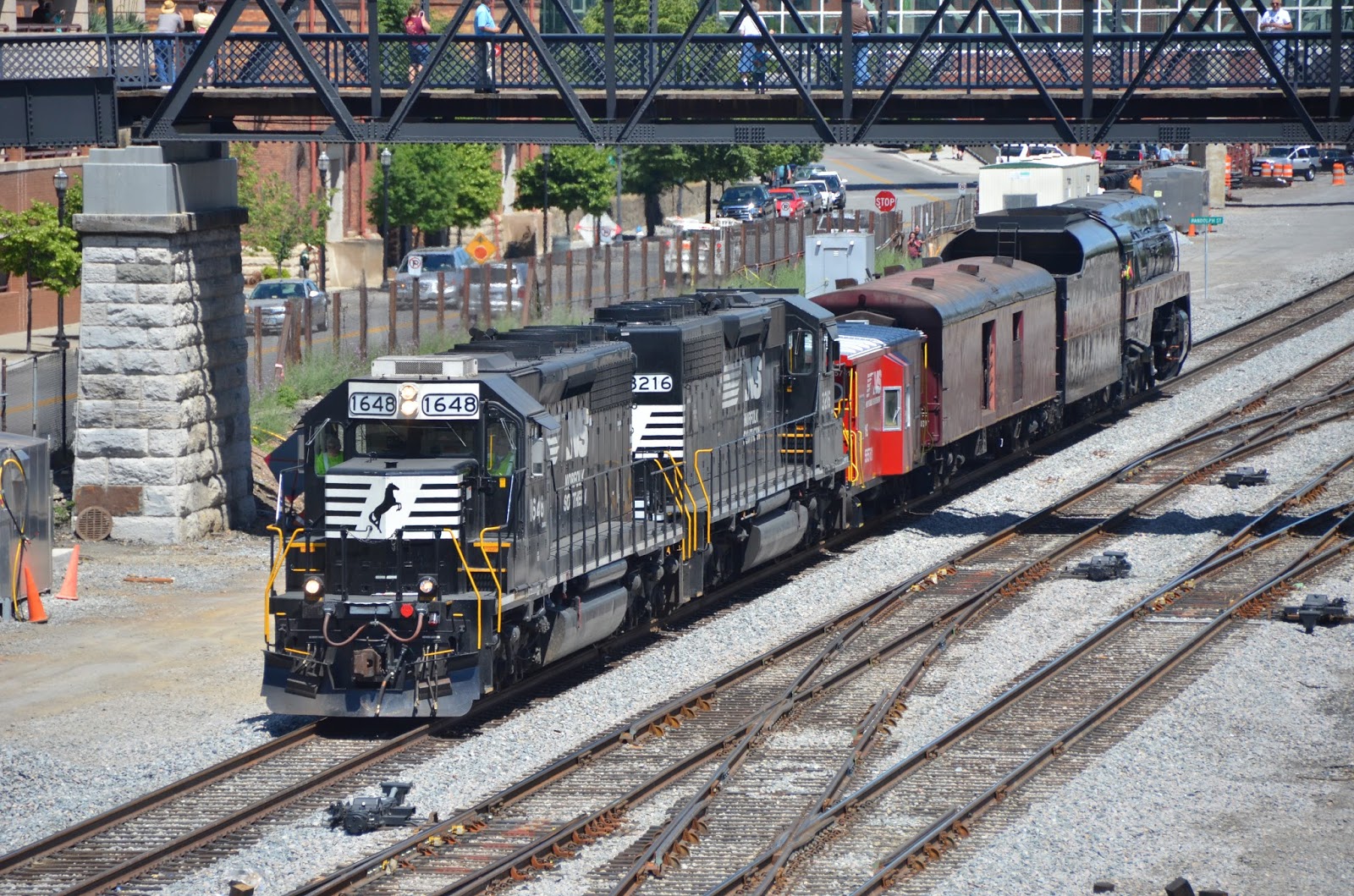
My first connection to 611 began on a hot and sunny day in May of 2014 when I drove down to the Virginia Museum of Transportation (http://www.vmt.org/) in Roanoke to see the locomotive off. That day the locomotive left the museum and was ferried down to the North Carolina Transportation Museum (http://www.nctrans.org/) in Spencer, North Carolina, for an overhaul and refitting to make the engine mainline and fan trip ready. While much has been written about the history of the N&W J series in general, and locomotive 611 in particular, the crowds of visitors who assembled that day in Roanoke were aware they were witnessing the beginning of the rebirth of a native son.[1]

Sixty-four years earlier N&W Class Js 611-613 were constructed in the N&W Roanoke Shops making them the very last batch of steam passenger locomotives constructed in the United States. The locomotives were completed between May and July 1950 and began service just as the outbreak of the Korean War grabbed national headlines. 611 rolled out of the Roanoke Shops that May with a price tag of $251,544 dollars, 80,000 pounds of tractive force, 70 inch drivers, roller bearings, a streamlined design created by N&W’s Mark W. Faville and Frank C. Noel, and a top speed in excess of 100 mph on level terrain, making the machine arguably the absolute pinnacle of 20th century steam passenger locomotive engineering.

That last group of passenger locomotives only saw service for nine years and 611, through the kind intervention of among others –the late great R. Graham Claytor- was the only locomotive to escape the scrappers torch. It was ironic that the locomotive had to leave its birthplace for an overhaul but in the early twenty first century most people in Roanoke were just happy to see the 611 moving at all. The fact the locomotive would return in a year under its own power made a seemingly embarrassing tow by Norfolk Southern diesels acceptable in the short term.

As a historian of technology by training, and a model railroader by choice since childhood, I traveled to Roanoke that day not just to see the locomotive but also to people watch and observe. I was intrigued by the cultural response to 611 that had a public life and resonance far out side of southwestern Virginia. In graduate school I read David Nye’s American Technological Sublime, a book that examines the American preoccupation with large and complex technological projects such as dams and railroads. I was rereading Nye in my head that very hot day in Roanoke and thinking what 611 might possibly mean for the various people who made the effort to be there. In discussing the reaction of people present at the opening of the Golden Gate Bridge Nye wrote the following:

The sublime underlies this enthusiasm for technology. One of the most powerful human emotions, when experienced by large groups the sublime can weld society together. In moments of sublimity, human beings temporarily disregard divisions among elements of community. The sublime taps into fundamental hopes and fears. It is not a social residue created by economic and political forces, though both can inflect its meaning. Rather it is an essentially religious feeling, aroused by confrontation with impressive objects, such as Niagara falls, the Grand Canyon, the New York Skyline, or the earth shattering launch of a space shuttle.[2]

As I watched 611 move out of the museum complex and onto the Norfolk Southern (former N&W) mainline that day, surrounded by hundreds with smartphones and cameras, I wondered if in 50 or 80 years the citizens of Mountain View, California will line the streets and highways bringing their children and grandchildren to witness the return of first Google pilotless automobile. I say this not to be facetious as the engineers, scientists, and technicians who have worked for years on this new technology (a number off whom are no doubt graduates of my Alma Mater) have much to be proud of. My guess is… probably no… for various reasons. The most important one being that there really is a power and majesty to a large steam locomotive running at speed, or sometimes even just standing at rest, which a hybrid drone/automobile just cannot match, no matter how path breaking technologies it contains. I will get back to you about this with a more definitive analysis of this question in 2065.


Charlottesville, Virginia: June 3, 2015

To be honest, my initial encounter with 611 in Roanoke left me intrigued but rather underwhelmed. This changed in a dramatic fashion when 611 made it way north to Charlottesville from Roanoke via Lynchburg on the old Southern, now NS mainline between Washington and Atlanta, on a dreary and very rainy June day. While I occasionally find myself trackside photographing trains, I am not really a “railfan” and do not own a scanner nor do I frequent many of the online chat groups where enthusiasts shadow trains and specific locomotives like military intelligence operatives. As such my approach to 611 was to essentially “wing it” which has always worked out well enough in the past.

Once 611 arrived back in Roanoke on May 30th to begin excursions I followed things online as best I could and hoped to catch it going northbound and southbound when it passed through Charlottesville on its journey to Manassas for the first weekend of railfan trips. A friend told me that 611 would be leaving Roanoke around 7:00 AM on June 3rd for Manassas via Lynchburg and my initial calculations had 611 passing through at the C&O/Southern (CSX-Buckingham Branch RR/NS) crossing around 10:00 AM. I arrived at 9:00 AM in a terrible downpour to secure a good spot for photography. There was only one other person there, a local high school student who had arrived sometime closer to 6:30 AM because he was so excited about 611 he couldn’t sleep. We had a long but ultimately satisfying day.

The bad news, which was also initially confusing as 611 just did not appear with each passing hour, was that the train would not arrive until about 3:00 PM. The heavy rain did not let up until 2:45 and was in fact so bad Internet and phone service was spotty at best making it difficult to track the train although that improved later in the afternoon. The good news was we were eventually informed that 611 would be STOPPING!!! in Charlottesville to pick up a VIP. That meant the possibility of getting a series of photographs depending upon the weather, the crowd I anticipated might show up, and most importantly how long 611 might be staying.

As it turns out the locomotive stayed about 20 minutes, which may have been the best and most exciting slice of railroad time Charlottesville has seen in decades. Being out of the loop I was not even sure 611 would be under its own power when it arrived, and yet the first time I saw the locomotive it was under a full head of steam pulling a long line of varnish headed to my favorite local “railfan” spot. Life does not get much better. Seeing and hearing 611 come into view really was breathtaking and I was glad I had the forethought to stay in the moment and enjoy the scene and also keep taking photographs.

It was my hope that day to photograph 611 at it crossed the CSX/NS crossing which was the one photo I most wanted regardless of weather. However, that was dependent upon how many Norfolk Southern folks were around when 611 finally arrived because to shoot at the right perspective would involve the dreaded T-word. As I discovered July 4th weekend, NS personnel bent over backwards to accommodate railfans and anyone else with a camera standing trackside –which sadly some people abused anyway- but I did not know that while standing in the rain on June 3rd.

In the final twenty minutes before 611 arrived the station parking lot and work area near the track at the diamond filled up with NS vehicles and with people arriving with cameras. Just as many arrived with their families for what might be a once in a lifetime opportunity. Lots of rail fans poured in too in the last few minutes and what had been just two wet guys with cameras expanded slowly to about 20 people and then suddenly grew to a hundred or so. With about 15 minutes to go I was thinking I had never seen so many NS employees before anywhere, much less in Charlottesville. As the crowd of railroad personal and civilians like myself grew and I realized taking a diamond shot was probably impossible, which was fine, since I was still well positioned to get some kind of useful photograph.

What happened in the final 10 minutes before 611 arrived made me a lifelong fan of Norfolk Southern. Having staked out a spot at the end of the platform I was the first photographer in line for a shot. Until I wasn’t, and another person with a camera went around me and set up his tripod right in front of where I had been standing. When I asked him to move I just received a dirty look. I was going to start arguing with this person when a NS employee pointed at me and told me to come over to the parking lot. At that moment I was not only frustrated and angry, but I thought I was probably going to be the only person who was reprimanded that day and took no photographs at all. This was particularly devastating, as I had waited for six straight hours in the rain. Regardless, I walked over into a large group of NS people hoping I was not in too much trouble but was extremely doubtful as to my predicament.

The gentleman from NS introduced himself, his son, and asked if I was the fellow who had been standing on the platform all day in the rain. I replied that it was in fact me.[3] He invited me out of the rain and mentioned that he had seen me down at the tracks on number of occasions before and noticed I was always safe and mindful of railroad property. He gave me a chance to shake the rain off my hat and camera case and introduced me to some of the NS people that were there. At this point I was confused and worried I wasn’t going to get a good photo since I would now be positioned behind everyone on the platform. On the other hand I was relived I probably wasn’t going to railroad jail. Finally, this man looked at his watch and said 611 would be there in 4 minutes. He also said that since the platform was now extremely crowded with people it might be better if I accompanied him out to the crossing where all the NS people were gathering as he thought a shot at the diamond might make for a good photo.

The series of photos I took of 611 crossing the diamond a few minutes later are not the best railroad photographs I have ever taken but they are among my most cherished.

Aside from the kindness and forethought of a stranger, I have to say I was also overwhelmed in the next few moments by 611 itself. The locomotive was, of course, streamlined but also more powerful and brutish than I expected and completely different than the machine I had seen pulled out of the museum in Roanoke a year earlier. Under her own power, belching smoke, and with a deep bellowing whistle that must be heard in person to be fully appreciated, I now understood that 611 was, for lack of a better description, a linebacker of a locomotive.[4] Here was a machine that could pull passenger trains through the mountains at speed, keep to the timetable, and not look back.

As I shot photographs of 611 from both the Amtrak platform and the Main Street Bridge I was reminded not only of David Nye’s perspective but also the writings of the late David P. Morgan.[5] In addition I remembered why I had started “playing” with trains as a very young boy. A number of the children present that day seemed awestruck by 611 and a few carefully poked at it with a finger and then quickly withdrew. If I were six I think I would have done the exact same thing.


Roanoke, Virginia: July 2-4, 2015

Having witnessed 611 up close in Charlottesville, I looked forward to the big excursion weekend in Roanoke over July 4th weekend. It is truism that one cannot see the locomotive if you are riding many cars behind as a seated passenger. I was fine with that as I planned one day of riding behind 611 and one to two days of being trackside with my camera. Although to be fair the sinusoidal nature of the N&W mainline in many of the mountains south and west of Roanoke gives a photographer more chances to capture the locomotive than one might think, something I discovered a few years back on an excursion to Bluefield.

I arrived at the former N&W hotel complex on the afternoon of July 2nd so I would have relatively quick access to 611 over the rest of the weekend. As it turned out I chose the correct day to be a passenger as July 3rd was overcast and rainy. My day began at 6:00 AM when I awoke to try to catch 611 coming down from the engine terminal as it brought the train in facing EB to go to Lynchburg. I took some good photos and was amazed how many people were already out and ready to track 611. That morning I took The Powhatan Arrow excursion 98 miles from Roanoke to Lynchburg and back that ran from 8:00 AM to noon. My accommodations were deluxe as I earlier wound up purchasing a ticket for a Great Northern full dome car. My seat next to the window afforded a wonderful view of all the trackside sights. Not being a native Virginian I am always interested in observing rail lines and countryside that are not easily accessible and found the trip quite interesting and very enjoyable from an observational standpoint.

That morning trip was also memorable for two other reasons. First, I was able to witness the large number of people almost continuously trackside along the 611 route, many in places that indicated NS was being especially open minded about photography all weekend. The most impressive vantage point was a farmer who had a cherry picker on his property, and who looked down on us from a considerable height as we passed his property. The second thing I recall is, I believe I was the only person in that car who had not attended Virginia Tech, or so it seemed. After turning on the wye in Lynchburg we returned to Roanoke although not before surprisingly slipping quite badly a few miles out from the station.

Upon our return I was forced to detrain but was told by a car attendant to stay at the front of the line so I could access a good seat. His advice was quite useful, and in half an hour I boarded the train a second time, now in a more standard coach, for the afternoon excursion. The Pelican, or at least a much shorter version, ran the most picturesque and exciting part of the entire excursion summer, from Roanoke, Virginia to near Radford, an 84 mile round trip that included the famed Christiansburg grade. The 4-8-4 Js were designed in part to conquer that particular grade with a long string of heavy mail and Pullman cars in tow, and over July 4th weekend 611 did not disappoint. The excursion ran from 1:30 to 5:30 PM and the power of the locomotive was readily apparent to watchful passengers who tracked speed and distance the old fashioned way by counting mile markers –which I did- or using up to date GPS software on a laptop- the approach used by my seatmate. Although the weather was miserable all day, the number of people trackside was amazing, and it seemed every person in the county was out in Christiansburg. The trip was also useful as I was able to choose possible places to railfan on July 4th.

July 4th dawned as foggy and miserable as July 3rd. Although by late morning the sun finally came out, and by the time 611 returned from Lynchburg with the morning excursion run, photographers were able to capture 611 under a full summer sun. I was lucky enough to be trackside, too. My first attempt to capture 611 on the way to Lynchburg was perfect…until my line of sight was blocked by a hotshot double stack train on an inside track that closed the gap and destroyed my chance for a photograph with only seconds to spare. Luckily things improved as the day progressed. Between the morning and afternoon runs I was able to get some wonderful photographs and video of 611 in downtown Roanoke. That afternoon I managed a truly wonderful photograph of 611 descending a mountain grade at speed near Glenvar, Virginia on the return leg to Roanoke That image was the photograph I had hoped to get when I purchased my ticket for the weekend many months earlier even though I had no idea when I arrived where or when I might be best placed to try shooting it. While that photograph is one I am very happy with, the most lasting memories I took from 611 this summer were not captured on film.


Conclusion: The Technological Sublime

Let me conclude this essay by sharing with you my two most substantial and unforgettable memories of 611 from this past summer aside from that act of kindness in Charlottesville. Interestingly enough, neither experience involves direct contact with the locomotive itself, although the memories of both encounters is fresh and are more real for me in many ways than any photograph that I took of 611.

The first event took place on Saturday of the July 4th Roanoke fan trip weekend. After riding behind 611 on two different back-to-back excursions the day before, I went trackside with camera in hand to try to capture the majesty of 611 out on the former N&W mainline. I drove north along the outskirts of Roanoke to the small town of Vinton, Virginia hoping to catch the return trip that morning from Lynchburg. I stopped and parked my car on a quiet side street in front of a home near a grade crossing. As I pulled in that morning, I wondered if I might be trespassing in some way, or maybe just giving the perception of trespassing, as the road seemed both public and yet also private. In the back of my mind a question of perhaps parking elsewhere persisted.

As I walked over to the grade crossing to get a line of sight for a photo I noticed an elderly man coming over to me quickly from the house near where I had parked. His expression was difficult to gauge although I was already reaching for my keys to move my vehicle and starting to apologize before he could say anything. He asked if I was there to photograph 611. I said yes. At that point he began to speak, and I began to listen. He told me 611 had gone by earlier on the way to Lynchburg and had never looked finer. He motioned towards the house and mentioned he had his grandson visiting in addition to many other family members, and he had wanted them all to see 611. He explained he had worked for the Norfolk & Western as did his father, his grandfathers, and many of his uncles, and that one of the latter had probably helped build 611, if not some of the other J’s. Some had retired from N&W while others had retired from NS. He noted he had never expected to see 611 run again and was thankful that the opportunity was presenting itself that July 4th weekend.

After a while I asked the gentleman if it was OK to park there, and he said that was fine, and I could stay all day. He wished me luck and hoped I got some good photographs. I asked him if he would like me to send him a set of the photographs later, assuming some of what I was hoping to shoot that weekend came out. He smiled, spread his hands wide gesturing towards the space between his home and the tracks and said he was thankful for the offer but he didn’t need any photographs. With the unobstructed view of the NS mainline from his front porch, I had to agree.

My “final” and most lasting memory of 611 actually took place before the July 4th excursion weekend at the desk in my home office where I am sitting at the moment. This was the week following the Manassas excursions as 611 passed through Charlottesville southbound to return to Roanoke via Lynchburg. I had a writing deadline that week and could not take time out to try to photograph the locomotive again. In addition the exact day and time of the return trip were unknown to me.

My home in Charlottesville is very close to the grounds of the University of Virginia and is not only one block from the CSX/C&O Mountain Subdivision -which I can see out the living room window in winter- but is also less than a mile and a half from the former Southern/NS mainlines. There is a large hill behind my place, and I rarely hear NS except very late at night although there is a lot of heavy mainline traffic. That day, lost in thought analyzing the environmental history of World War I, I was reading and typing with the window open and making progress. For a moment the world became still and quiet, and I suddenly heard a far off rumbling. I thought it was CSX but realized this was a different sound that was recognizable yet unfamiliar. It was 611! The locomotive was making good time and I could make out the sound of the running gear. Suddenly the whistle blew, and I could hear the locomotive quite clearly even though it was not very close. For a few minutes the locomotive grew ever louder as did the whistle and eventually the echoes faded completely away. And there I was, still sitting at my desk next to the window.

Before I wrote this essay I had “remembered” and replayed that sonic encounter over and over again in my mind and had assumed it had occurred after I traveled to Roanoke for the excursion weekend. It turns out that hearing that locomotive, which to me really was technologically sublime, occurred before I took hundreds of photographs in Roanoke and spent time behind 611 as a passenger. Seeing 611 down at the Charlottesville station in June was special for me because it was surreal to see the locomotive in my hometown. As it turns out having the locomotive “present” in my home, if only for a minute or so, is even more special. Hopefully 611’s return provided similar experiences for others.


[1] The most useful standard text on Norfolk & Western steam locomotives remains Lewis I. Jeffries’ 1980 N&W: Giant of Steam that was republished in a revised edition in 2005. This book has a wonderful chapter long analysis of the J series including detailed discussion of locomotive research and design practices, construction information, and of course passenger operations. For introductory information on 611 a Trains Magazine Special Edition entitled 611 in Steam was published in 2015 that contains past articles on 611 design, the history of earlier fan trips, and insightful coverage of the current restoration program that got 611 moving again. Finally the Norfolk & Western Historical Society has just published a book coauthored by Tim Hensley and Ken Miller that examines the 611 fan trips in the 1980s, 1990s, and in 2015 called 611: Three Times a Lady.

[2] David E. Nye, American Technological Sublime (Cambridge: The MIT Press, 1994) xiii.

[3] My high school friend had decided to photograph at the end of other end of the platform well past the Main Street Bridge and so might have remained unnoticed.

[4] Afterwards I was told by others that whistle on 611 is a refit and not correct. This may be true. I am not a N&W steam acoustics expert and to make matters worse have never heard those O Winston Link LPs. Regardless, 611 sounded pretty impressive to me each time I encountered it in 2015. I understand that the whistle for the 2016 fan trips will sound much closer to the original item.

[5] For a YouTube view of 611 leaving Charlottesville that rainy June day please see the following online: https://youtu.be/A2AS5RTVatY

Saturday, August 30, 2014

A Thousand Words…

Another guest post from Gerry Fitzgerald. This time he points us towards research tools (and cool photographs). And there is a really nice philosophical underpinning about the way Gerry pursues his passion for railroading - revealed in what Gerry believes is the purpose of history.  -rt

A Thousand Words...

by Gerard J Fitzgerald

One of the many seismic changes to American culture caused by the entry of the United States into World War II was the flood of women into the workforce on the home front. Many jobs, including positions in the industrial sector such as on the nation’s railroads, were filled by women who labored in spaces vacated by men who had been drafted or had volunteered for formal military service. Long standing cultural and gender bias was checked, if only in the short term, by the expediency of a global wartime emergency.


Evidence of such radical change is seen in the photo above. Taken in Clinton, Iowa, in April of 1943, this snapshot of industrial life along the rails shows Mrs. Viola Sievers working as a roundhouse employee, preparing (I believe…) a Chicago and Northwestern H-Class 4-8-4 “Northern” for service. Dwarfed by the driving wheels and boiler of this Baldwin built giant, Mrs. Sievers is understood in this photo to be a small yet vital part of a dedicated national rail transportation network focused on American and Allied victory. Without the onset of war Mrs. Sievers -or for that matter any other woman-would rarely, if ever, have been allowed near a locomotive in that particular capacity as a railroad employee.

The person behind the camera was Jack Delano, and his name, not to mention his photographic style and artistry, is recognizable and familiar to many in our hobby. Perhaps best remembered today by some for his wonderful contributions to cinema and folk music in Puerto Rico, Mr. Delanao was, in 1943, working for the United State’s Farm Security Administration and Office of War Information as a field photographer. His mission, which was just as important as Mrs. Sievers and the crew of C&NW 3034, was to record on film life in these United States for posterity. Delano’s federal patronage gave him access not only to restricted areas such as railroad property, sites which were generally off limits to all forms of photography during the war because of national security concerns, but also to exotic materials such as color film, which at the time was exceedingly difficult to obtain because of war time shortages. This project had been initiated in 1935 to capture the toll of the Depression on the lives of rural Americans and was continued on into the war years through various government agencies until 1944.


The use of color in lieu of black and white film during this period was another indication of changing times, here a reflection of the impact of science and technology on consumer life in the early twentieth century. For better or worse science marches on and in 2014, much like in 1943, people are working to create and make available new devices and systems to enhance/complicate our way of life. At the same time the tools and methodologies that people use to investigate the past also continue to expand and evolve. This includes how we access and process photographs such as the ones taken by Mr. Delano back in the 1930s and 1940s.

Since at least the 1980s -and one can argue that the origins of this type of research goes much further back in the last century- work by scholars who were at the time considered outside of the traditional scope of social scientific research, much less the humanities, have worked synergistically with historians, anthropologists, archeologists and other academic types to create an entire new field called Digital Humanities. The field is considered so promising that in the United States the National Endowment For the Humanities (NEH) launched a formal initiative to encourage and fund this type of research in 2006. This sequence of events is, for a select group of humanists, very similar to when physicists were surprised to find out in the late 1930s that an understanding of neutron capture and fission was a license to print money. But I digress…

What the digital humanities is exactly, much less what the field can do, or what some practioners hope the field can accomplish in the future …is a very complicated and often contentious question. From a practical standpoint those issues are not really a pressing concern for any model railroaders reading this blog post. Although if you are really interested consider going to the page entitled “A Guide to Digital Humanities at Northwestern University (http://sites.library.northwestern.edu/dh/) or “Debates in Digital Humanities at CUNY (http://dhdebates.gc.cuny.edu/) but pack a lunch because you’ll be reading for some time, possibly for at least a few weeks. Be forewarned! If a sentence which reads in part “Despite the significant trend in Digital Humanities towards networked and multimodal spanning social, visual, and haptic media…” sounds like it was lifted from an Onion article (it wasn’t!), or just gives you a headache (it shouldn’t), just skip down one paragraph where I get to the point about how your tax dollars are paying off to facilitate your hobby needs.

For the record, Digital Humanities is defined on Wikipedia for the folks still reading in the peanut gallery in the following way:

An area of research, teaching, and creation concerned with the intersection of computing and the disciplines of the humanities. Developing from the fields of humanistic computing, and digital humanities praxis (dh praxis) digital humanities embrace a variety of topics, from curating online collections to data mining large cultural data sets. Digital humanities (often abbreviated DH) currently incorporate both digitized and born-digital materials and combine the methodologies from traditional humanities disciplines such as history, philosophy, linguistics, literature, art, archeology, music and cultural studies) and social sciences with tools provided by computing (such as date visualization, information retrieval, data mining, statistics, text mining) and digital publishing. As well, related subfields of digital humanities have emerged like software studies, platform studies, and critical code studies.

So what does any of this have to do with that Sunshine kit you squirreled away five years ago into that secret closet in your basement and which has been gathering dust ever since? Well quite a bit as it turns out. There is a new Digital Humanities initiative at Yale called Photogrammar (http://photogrammar.yale.edu/) which is a “web-based platform for organizing, searching, and visualizing the 170,000 photographs from 1935 to 1945 created by the United State’s Farm Security Administration and Office of War Information (FSA-OWI).” This is without doubt the niftiest thing to come out of the New Haven campus since Cole Porter.

From a model railroading standpoint this means that all those wonderful Jack Delano color photographs taken in the wintery Midwestern hinterlands during the 1940s, photos which RPM types love to drool over and incessantly argue about, are available in a new and more interesting format. Plus hundred of other photos Mr. Delano took which you probably haven’t seen. Not to mentions tens of thousands of other photos taken by greats such as Dorothea Lange, Walker Evans, Gordon Parks, and some other not so famous names, all of whom worked on what was the largest photo project ever undertaken in American history. (For a new PBS documentary on the life and work on Dorothea Lange please see the following: http://www.pbs.org/wnet/americanmasters/) These artists and visionaries bequeathed to us a photographic vision that not only shaped our understanding of the terrible effects of the Great Depression on the nation, but, in so doing, also created a visual collective memory of the American landscape that guides our hearts and minds to this day.


Aside from the photographs the Yale site makes use of Digital Humanities software that allow users to find photos by state, by date, by photographer and also provides graphic analysis of photographs by category (http://photogrammar.yale.edu/labs/). The site is very easy to use and builds upon the collective experience of mining the photo page at the Library of Congress: (http://www.loc.gov/pictures/collection/fsa/).

What modelers do with this wonderful new resource remains to be seen but time will tell. How “history” is employed within the hobby, and to what ends, is a topic that holds a great deal of interest for me and to be honest sometimes gives me a headache. Historical evidence comes in various forms and a photograph is a particularly accessible type of evidence especially in the age of the Internet. And yet a photograph can often be a very tricky primary document to wield, much less interpret, even as it remains a potentially powerful tool.


One of the other photographers involved in the FSA-OWI project was the late great Walker Evans who is a hero of mine. Evans, along with the writer James Agee, produced a book on the eve of American entry into World War II that chronicled their work exploring the lives of impoverished white tenant farmers in Hale County, Alabama, in 1936. Of the many works produced by scholars, writers, artists, photographers and journalists about the dramatic impact of the Great Depression on life in the United States, Agee and Evans’ 1941 book, Let Us Now Praise Famous Men, has achieved the status of a modern classic. One of the most unique and idiosyncratic publications of its day, the book combines Agee’s words and Evans’ photographs resulting in arguably the most significant documentary examination of the era of rural American life in the impoverished South. The book draws readers into the lives of those who labored and also into the spaces in which they lived. By focusing in part on rich descriptions of the sensory, spatial, material, and architectural aspects of a particular vernacular landscape, the authors created a powerful and often indelible historical image that, even today, has purchase in how Americans remember the rural South at that time.

Amazingly enough James Agee and Walker Evans went south to Hale county under contract for Fortune Magazine (yes THAT Fortune Magazine!) to chronicle the lives of enervated and near penniless sharecroppers. Apparently the editors passed on assigning the piece to Karl Marx as he was still dead and John Dos Passos was still editing the proofs of The Big Money. Agee realized early on his prose would probably not find a home in Fortune, knew he could still sleep soundly at night if that was the case, and bided his time. Both his words and the Evans photos reached a limited audience five years later when the 600 copies of the first edition made their way out into a country that was gearing up for war. It languished for a time but a small audience of astute observers recognized upon release that the book was a classic. Over time the book has become somewhat controversial, especially to the descendants of those photographed. Regardless, the book’s importance in American history flows out of photos and text that bore witness to forms of rural poverty and extreme material deprivation that was startling to many Americans in 1936. Such poverty, which still exists today in various locales, is equally disturbing almost eighty years later.

The photographs in the collection that the Yale platform has so graciously repackaged for everyone’s use provide a wonderful opportunity, not only as a visual and historic resource, but perhaps more importantly as a stepping-off point for objective analysis, discussion, and perhaps even personal introspection on the various meaning of American history. To paraphrase what I said on a model railroad chat group last year (when I was discussing the inherent complexities of modeling the Jim Crow South…): While some in the hobby do seem to want to embrace the nuance and complexity of American history when it increases the realism of their modeling endeavors when it comes to technologically determinist features such as rivet detail, prototypically correct paint schemes, operational minutiae, layout design, signal systems, and chronologically distinct weathering effects to name but a few examples…many place very specific limits on how much of the larger American cultural experience they really want to model. The type of details found for instance in a close reading of the photos taken by Delano, Evans, and Lange, among others back in the day.


Which is fine…as far as it goes… although history makes less sense if one cherry picks or filters culture through a cheesecloth. To be more precise and to the point, history is not supposed to make you comfortable - it is supposed to make you THINK! Which is why the new online archive from Yale is such a useful tool. This wonderful treasure trove of photos, coupled with the powerful new graphic and search capabilities available on the Yale webpage, will give all of us the opportunity to think carefully about what we see in these images of the American past. Because in the final analysis how we see the past, and how we struggle to objectively interpret history, ultimately tells us a great deal about how we view ourselves.

Monday, August 25, 2014

Guest post: Good-bye to All That: Railroad Model Craftsman (1933-2014)

The following is a guest post from Gerry Fitzgerald on the occasion of the suspension of a beloved publication. Gerry is a great friend and great thinker, but he is also a great modeler - largely due to his favorite publication. Is is important to note that Gerry is also a high-caliber historian and academic, which prompted him to place the magazine, personalities and ultimately himself in the rich and evolving context of model railroad history. 

I think you'll find his voice unique, clear and ultimately entertaining, and if you appreciate his contribution, please say so in the comments section so that I can get him to contribute more of his insightful commentary and deep knowledge of the hobby to the blog. -rt


Good-bye to All That: Railroad Model Craftsman (1933-2014)


by Gerard J. Fitzgerald

Craftsman [krafts-muh n, krahfts-]
noun, plural craftsmen.
1. a person who practices or is highly skilled in a craft; artisan.
2. an artist.

The unexpected closure of Carstens Publications this past Friday, and the end of Railroad Model Craftsman as a going concern, at least for now, is a very sad day for the hobby of model railroading. If you have been a serious or even a semi-serious model railroader for any number of years you no doubt read or subscribed to Railroad Model Craftsman (RMC) at one time or another over the years. If you are of a certain age it is probable you have a large collection of that magazine close by, perhaps bound chronologically in binders in a bookcase or more likely arrayed less neatly in piles on a shelf somewhere in your home, probably under your layout. 

The interwar period was an interesting time for model railroading and for model railroaders. The use of the term craftsman makes sense as those who were engaged in the scale modeling of trains, ships, aircraft, etc…often had to scratch build many of the necessary components needed for their hobby. While there were certainly various commercial distributers of various kits and parts for locomotives, rolling stock, power supplies, and track components, one needed to be handy with a lathe, calipers, volt meter, soldering iron, files, paint brushes, and a host of other tools, not to mention various precision instruments (if they could be afforded), in order to make a successful go of it. In addition, a familiarity with the ability to read blueprints and formal plans (assuming one had access to them) was also often a necessity. 

Many are keeping their fingers crossed that in the very near future Railroad Model Craftsman will be production once again in a somewhat different form, perhaps under a new guiding hand. Regardless of what the future may hold this is a doleful time for the hobby. More importantly this is an even worse day for those who have worked at the magazine, especially those who were employed there when the week began. Although I am sure they knew the end was coming that in the end could not have been much comfort. Since everyone else is weighing in with thoughts on various model railroad sites I asked Riley if I could put in my two cents…A few thoughts then from an avid reader about the magazine that has often guided my approach to the hobby beginning when I was a small boy and has continued to do so until this very day… 

One of the most obvious ways a commercial magazine defines its mission, both to the editorial staff and just as importantly to the readers, is the title. The title not only identifies what type of content lies within, but also acts as a lure to reel in potential customers. In the case of niche magazines, such as those dealing with hobbyists, the title may also reflect a goal or perhaps more specifically an identity for the reader themselves. 


This is not always the case, as there are only so many words and combinations available, but in many ways a reader is, or hopes to someday become a Model Railroader, or a Model Railroad Hobbyist, or a Railroad Model Craftsman by reading and learning from the magazine in question. The choice of the term “craftsman” was a wonderful one, an inspired choice in fact for those who are goal driven and wish to learn how to master various techniques and ultimately make themselves much more well rounded with respect to their skill set. As defined above “craftsman” indicates a very high, if not the highest, level of technical expertise in a given trade or occupation, a level of expertise that can be defined in some cases as art.


The term has various historical meanings that have evolved over time but for the magazine in question, the time and place of birth was the United States during the Great Depression. Emmanuele Stieri, who was undoubtedly an optimist, founded The Model Craftsman Publishing Company in Chicago in 1933. In March of that year, when the Depression was reaching its full force, the first issue of The Model Craftsman appeared. It was a problematic time to begin a new publication devoted to leisure activities (Sadly Thorstein Veblen passed away in 1929 and never had the chance to pick up a copy) and the next few years were quite rough although the magazine somehow managed to stave off the economic cataclysm that was destroying much of the country. While the magazine did survive it did not do so without experiencing various complications. 


Within a year of the first issue the company had pulled up stakes and moved to New York City. A year after that the company changed hands and a name more familiar within model railroad history, Charles A. Penn, took over as editor and publisher. Within five years Mr. Penn, would flee the high rents of Gotham and in 1940, move the magazine to Ramsey, New Jersey, a small suburban bedroom community along the Erie Railroad about thirty miles outside the city. Mr. Penn would stay at the helm until his retirement in 1962, replaced by former managing editor Hal Carstens.


Model railroaders during this time period, not to mention their fellow hobbyists engaged in building operational steam engines, ships and model aircraft, probably fell into readily distinct but occasionally overlapping groups of hobbyists whose approach to craft was defined in many ways along class lines, which was itself a reflection of education, expertise, and training.


The “professional craftsmen” -for lack of a better term- the customers most sought out for their consumer hobby dollars by those in the nascent hobby industry (those few manufacturers still making a good living in the 1920s and who were barely scraping by in the 1930s) were composed of two major groups of individuals. Leading the way, at least in theory, were college educated engineers, men who were trained to use tools and skilled in mathematics, made a very decent living, and had an abiding interest in all things technological. In addition there was a much larger cohort of equally well off, if not much wealthier professionals in fields such as law, medicine, banking, architecture, or commerce who were flush enough to outfit and purchase a home machine shop and also buy all the other various supplies and sundries needed to pursue their hobby interests. 

This latter group made up for their lack of formal technical training in engineering with energy, interest, and capitol. The remainder of the human hobby pyramid was made up of middle class and working class individuals, men who may have had less money to spend on the hobby but may have had much more hands on experience with tools and machine operation and came much closer by their job description to a traditional artisan or craftsman. What these individuals may have lacked in consumer dollars, they compensated for in tacit knowledge and the ability to build models of particular aesthetic beauty and mechanical reliability. 


Engineering culture was itself evolving during this time period as were manufacturing processes. The shop culture of professional engineering in the United States had evolved in the first decades of the Twentieth Century with a pedagogical shift towards a more mathematical approach to framing and solving problems, a shift that would only continue to accelerate. Hands on instruction leading to the mastery of a lathe and various machine tools was now augmented by increasingly sophisticated class room and laboratory based problem solving sessions in mathematics, physics, chemistry, mechanics, optics, thermodynamics, geometry, etc… The professional engineer was changing the American technological workscape and this in turn would alter in time how the hobbyist would model that workscape through choice of tool, materials, and perhaps most importantly outlook.


The point of this brief historical analysis is to put the word “craftsman” in some type of cultural perspective within the bounds of the world of American model railroaders during the 1930s when the magazine was founded. The word of course remained on the cover of Railroad Model Craftsman until just last week, which may demonstrate, among other things, the evolving meaning of the term for those within the hobby and also for those who write and report about it. While certainly not a completely plastic concept, the meaning of the word has been pulled and stretched in different directions over the years, changes that reflect the evolution of the hobby itself. Suffice to say while there are certainly overall similarities, the question remains open as to whether there exists a greater difference between a “railroad model craftsman” in 1934 than say in 2014 from a self-identification standpoint. 


Both The Model Craftsman and Model Railroader (Al Kalmbach began publication of Model Railroader in Milwaukee in 1934), having somehow survived the economic doldrums of the 1930s, probably found a somewhat easier time of it during the economic shortages and cultural upheaval found on the American home front during World War II. With most of the capable hobbyists otherwise occupied, and the vast majority of the materials necessary to either publish a hobby magazine, much less actually take part in the hobby of model railroading itself, out of reach, the hobby slowed until the postwar years. 


The immediate postwar boom of suburbanization and economic growth for much of the middle class accelerated change to those within the hobby and also those who were writing about it. The dawn of 1949 saw Charles Penn and his team change the name of The Model Craftsman to Railroad Model Craftsman, a change that reflected a new journalistic emphasis away from all the various scale hobbies such as ships and stationary steam engines to focus exclusively on model railroading. 


Outside of a direct historical perspective, understanding the changing meaning of the word “craftsman” within the hobby, and the importance of Railroad Model Craftsman to readers might be best accomplished by mentioning two important series which were published in Railroad Model Craftsman decades apart but which are still considered to be extremely important for the larger impact those articles had on the hobby. These two series also show the changing nature of how one might define being a model railroad craftsman. 


In addition, I will also briefly touch upon the March 1980 edition, which to me represents the magazine at its best. The publication of Allen McClelland’s articles on his Virginian & Ohio as an eight part serial between January 1977 and March 1978 was a watershed event in the hobby for those interested in realistic operations and layout design. In 1984 a book version, The V&O Story: How the V&O Was Built was published by Carstens Publications, a text that included additional RMC articles by other authors dealing with V&O operations and design. (1) The book and the series remain essential reading for those interested in designing, building, and operating a miniature railroad transportation system. 


One of the lasting contributions in this series was McClelland’s concept of “good-enough” modeling, an approach that in many ways showed the evolution for some of what was a self imposed upper limit on craftsmanship, a glass ceiling that might appeal to particular modelers depending upon the given circumstance. Here the approach was to do more by really doing less, perhaps a form of metacraftsmanship. 


McClelland was in some ways the logical extension, if not the conclusion, of layout construction, design, and operation concepts that were popularized by an earlier generation of other modelers such as Frank Ellison. When Ellison published his first article in Lionel Magazine in January of 1932, the goal of many model railroaders was to complete a small operational loop of track on a shelf around the heater and coal bin in the unfinished basement, an undertaking involving enormous investments of time and energy. This might involve building many of the components not available in catalogs, and as often as not significantly altering other items which were available off the shelf for greater scale viability.


Two generations later at the time McClelland was publishing in the 1970s, the unprecedented availability of items in HO scale gave certain modelers the option to pursue operations at home in a manner heretofore available only as an option in elite club venues. Here the choice was to pursue craftsmanship in a different manner. The goal for modelers like McClelland was apparently the layout itself, as an operational mechanism like a basement sized cuckoo clock or early electromechanical computer with trains moving along in a specific prototypical manner. Prize winning detail was still to be pursued in some cases for locomotives, rolling stock and structures but only as a secondary consideration, as an additional feature once the layout was operational and car cards were moving in tandem with trains. 


The “good-enough” philosophy was, of course, just one approach to craftsmanship, if not a new form of craftsmanship altogether that appealed to operations minded individuals. There were, of course, other possibilities including more traditional techniques. One example involved prototypical focus not on locomotives but for the first time increasingly on rolling stock. 

What is now generally known as the Railroad Prototype Modelers (RPM) movement began during the 1970s, if not earlier, and many authors found in Railroad Model Craftsman a welcome place to publish detailed articles on altering rolling stock to match specific historical prototypes. While RMC was not the only magazine that made room for such work, Model Railroading and Railmodel Journal also published such articles in large numbers, neither survived into the new millennium. Although such articles by various top flight authors and modelers became a regular feature in Railroad Model Craftsman, the “Essential Freight Car” series by modeler Ted Culotta resonated with mainstream hobbyists in much the same way McClelland had in the late 1970s. 

The Culotta series of articles began on the topic of war emergency gondolas in August of 2001, and continued onward for the next eight years, through forty-five installments, ending in the July 2009 issue with a feature on AC&F Type 11 tank cars http://www.steamerafreightcars.com/prototype/research/EssentialFreightCars.html. The series sparked an interest by modelers in adopting an RPM approach to rolling stock, a subject that many had previously been unaware of, or, perhaps had just found uninteresting. 

The Culotta series involved the super detailing of various freight cars that the author, who had done impeccable historical research, argued were needed to build a balanced and prototypically viable freight car fleet for operations during the steam to diesel transition period. The series also acted as an advanced primer into the technological history of freight car construction in the first half of the last century. Here was a counterbalance to the good enough philosophy; here modelers were drawn into the intricacies of resin fright car construction, specific decal approaches and weathering, and also historical research to become craftsman is a way that was certainly traditional but also involved state of the art approaches to modeling and research.

Let me conclude this post with some observations about another form of craftsmanship associated with the magazine. In many ways this is the most obvious kind of craftwork, although it is often invisible to many. This is the care and work that went into putting the magazine together in the first place and hopefully giving it a unique and familiar voice. It is unfair of this author to not mention all the various editorial staff members (I apologize!) but for the sake of expediency I will only talk about some of the work done under Tony Koester. 


Interestingly enough I have spent part of the summer rereading, sorting, giving away, and throwing out boxes and boxes of model railroad magazines after cleaning out a storage facility near my home and deciding once and for all to cull my collections down to something more portable and manageable. Which is a long way of saying I have been rereading lots of magazines that generally go back into the 1970s and in some cases all the way back to the 1950s. Being old fashioned and a bibliophile I still cut out articles I find especially useful and slide them into plastic sheets and eventually place the sheets in binders divided by subject for later reference. The magazine, which is being kept both whole and also being sliced up the most for future use, is Railroad Model Craftsman. As a disclaimer, let me note that this might best be interpreted less as an indictment of other modeling magazines and more about my personal approach to the hobby.


So, in spending part of a summer perusing hundreds of model railroad magazines what have I learned?(2) Well, many memories flooded back which made me think about how I learned about the hobby. I recalled finding an old used copy of Railroad Model Craftsman in a hobby store discount box, which featured the seventh installment of the V&O story that focused on operation. Much was later made in the Layout Design Journal, and various online spots about the Tony Koester/Doug Gurin/Allen McClelland synergy that made the series possible. Interestingly enough I later became good friends with Tony and Doug, but at that time I had no idea who these gentlemen were or what I was reading.


The V&O series was, I must admit, something I didn't quite understand at first glance, and I also recall that I read the series out of order. I was sure however that this was somehow an important model railroad, and perhaps more importantly, this McClelland fellow had what seemed to me an advanced way to approach the hobby. I wasn’t quite sure what an advanced approach might actually be but this seemed to point the way… At the time I knew no adult model railroaders and had no access to any clubs so my approach to the hobby was in many ways grounded in what I could gleam from magazines.


This post includes the cover of the March 1980 issue of Railroad Model Craftsman, which after a summer of model railroad review seems to be as good as anything that Carstens produced. (3) If a person can have a favorite single issue of a magazine, this might be it for me as I always found the editorial and modeling by Tony Koester entitled “Changing Times at Big Spring Junction” to be quite insightful. It sort of encapsulates the V&O series with one page of photos (plus the cover) and one page of text, which I suppose was the point. At 130 pages the issue seems slight but is packed with articles and also lots of ideas, which sounds normative but is more exceptional than a reader might think.


One feature I hadn’t noticed, or remembered was that one of the main articles entitled “Inglis: A Small Village in Northwestern Manitoba” was by a woman named Betty Jackson. Sadly, one thing that hasn’t changed much since 1934 is the makeup of the hobby from a diversity standpoint, but I was surprised and gratified to see the piece by Ms. Jackson especially back in 1980. An article that shows that “craftsman” is a term much like actor and has no gender specificity. In addition, the issue had articles by Jim Findley, Malcolm Furlow and Allen McClelland and the first of a two-part article on scratch building an L&N bridge over the Little Kentucky River by John Campbell. The bridge article was also linked to the “Observations” article by Alan Bates and Charles Buccola who went out in the field, and literally hip deep into the Little Kentucky River to shoot another prototype shot of the bridge, as requested by Tony Koester.


This type of model railroader/railfan feature was not unique to RMC in the 1980s but it was certainly never done better anywhere else as far as I know. Perhaps the most interesting driving force in RMC during this time was the “Editors Notebook” where Koester would think out loud about various projects and also detail in real time the success, and occasional failures he was encountering as he constructed the Midland Road. While “Trains of Thought” in Model Railroader is a wonderful feature, the real thinking occurred in these longer form editorial pieces back in the 1980s, where the editor was provided the room and freedom to tackle many issues in the depth they deserved.


That issue’s “Editor’s Notebook” featured two large black and white construction photos of bench work before the hand laying of track had commenced. My clearest memories of those earlier issues are of the “Editors Notebook” and in rereading them it is clear the editor was doing more than just thinking out loud, in many ways he was demonstrating different forms of craftsmanship both at the keyboard and down in the basement, where he explained both how and perhaps more importantly why he was constructing a base sized model railroad. It was this conversation he was having with the reader, as were many of the other authors and staff members whose work appeared, which made reading Railroad Model Craftsman so both enjoyable and instructive.


In the time before the Internet was available to those outside of DARPA, a boy or girl on their own in the hobby was guided by the hobby press, and Railroad Model Craftsman (and also Model Railroader) were ideal companions and tutors. In addition, reading Railroad Model Craftsman in New Jersey, where I grew up as a boy, was also exciting because the magazine was itself published in the Garden State. In fact, at one time it was published a few miles down the Erie mainline from where I was raised in the now infamous Ramsey Journal Building, a structure that was once a kit manufactured by AHM.(4)


I had the privilege of visiting Carstens Publications after they left Ramsey for Newton, New Jersey, a few times as a high school student - I grew up in New Jersey- and it seemed like an interesting place as far as it went. What I most remember, and which was eye-opening to me at the time, was that it was just an office out in the middle of nowhere (and to be fair still in the middle of nowhere which is hard to do in New Jersey) with people just sitting at desks doing work, no trains or layouts present except for a few locos and pieces of rolling stock that were under review. It was clear later this should not have been surprising as it was an office although perhaps I just expected something more magical.


But magazine work is not magical, especially when it often involves editing the work of people who are not for the most part professional writers. In the cold light of day magazine work is really all about the day to day tedium of writing and editing which involves a great deal of sweat equity about comma-splices and the active voice. It is not a Willy Wonka dreamscape infusing with the best of John Allen and George Sellios, a fact that often escapes the notice, or is perhaps just simply beyond the comprehension, of many model railroaders.


In the end, this was about work as craft, and for decades many people put in long hours and more often than not produced a wonderful product. Carstens Publications was not without its problems (paying authors always seemed to be a problem year after year which raises the question how they could have run out of dough…). But in the end it was the staff, month after and month, year in and year out who gave people something wonderful to read. It also gave some of us something to aspire to, perhaps someday becoming a railroad model craftsman.


All I can say is…Thanks!


Footnotes
(1) For more on the V&O see by the author, “More Than Good Enough: Some Thoughts on the V&O Story on the Occasion of the 50th Anniversary of the end of Steam Operations on Allen McClelland’s V&O,” Layout Design Journal, 39, Fall 2008, 54-59. See also by Allen McClelland, The V&O Story: How the V&O Was Built (Newton: New Jersey: Carstens Publication, 1984).

(2) I was surprised by the changing personality of various magazines over time, which may or may not reflect the corporate culture of those controlling the purse strings and also the various machinations within the editorial staffs, although I assume both of these phenomenon are strongly interrelated. The magazine I was most looking forward to re-reading was in fact Mainline Modeler, a journal which now strikes me as a wonderful repository of advanced techniques and historical and prototype information but also positively antiseptic and soul less from a narrative standpoint. Maybe a blog post on that in the future...maybe not.

(3) The price tag is from the now departed Mitchell’s Hobby Store a main stay in Willington Delaware until it closed after 50 years a number of years ago (and a smaller and in fact nicer store opened down the street). I usually skipped magazine subscriptions so I would have an excuse to frequent my local hobby store once a month but that is becoming more difficult as those sorts of places fade away.

(4) For those interested in multiple layers of interlinked hobby minutia, the Ramsey Journal Building kit was the basis for the structure that housed the V&O Historical Society on the original Virginian & Ohio layout. A factoid which might (?) be of interest only to people reading this blog post or perhaps an American Studies graduate student interested in mining for cultural lacunae in late century American male hobby pursuits. And even within those two subgroups it might be a reach...